
Odimmegwa Johnpeter/Abuja
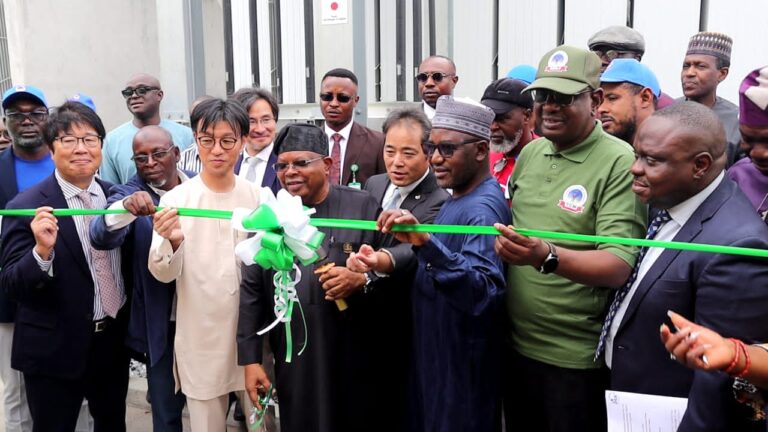
The Minister of Power, Mr Joseph Olasunkanmi Tegbe, has commissioned two major transmission infrastructure projects in Lagos, with the interventions collectively increasing transformation capacity by 252MVA and strengthening electricity supply to critical commercial and industrial areas.News
The projects, located at the Apapa Road and Ijora transmission substations, are expected to improve bulk electricity supply, reduce transmission constraints and support economic activities across Lagos.
At the Apapa Road 132/33kV Transmission Substation, Tegbe commissioned a new 2×60MVA Gas Insulated Substation (GIS), describing the project as a strategic investment in one of Nigeria’s most economically important corridors.History
The minister said Apapa was a major economic hub hosting ports, maritime services, logistics companies, manufacturing facilities, warehouses and other businesses whose activities have implications beyond Lagos State.
“Apapa is not an ordinary electricity load centre. It is one of the commanding heights of the Nigerian economy,” he said.
The project, according to the Transmission Company of Nigeria (TCN), increased the substation’s capacity from 60MVA to 180MVA through the installation and energization of two new 60MVA transformers and modern GIS equipment.
TCN Managing Director/CEO, Engr. Sule Ahmed Abdulaziz, said the upgrade would provide additional bulk electricity for Eko Electricity Distribution Company (EKEDC) to supply customers in Apapa Causeway, Ijora, Amukoko, Ajegunle, Apapa Wharf, Tin Can Island and other commercial and industrial areas.
Abdulaziz said the project was sponsored by the Japan International Cooperation Agency (JICA) in partnership with TCN under the Emergency Rehabilitation and Reinforcement of Lagos Transmission Substations project.
He disclosed that the project was delivered by Takaoka Engineering Co. Ltd., with implementation commencing in 2019 following a grant agreement between the Federal Government and JICA signed in November 2018.
At the Ijora 132/33kV Transmission Substation, the minister also commissioned two new 100MVA transformers, raising the facility’s installed capacity from 90MVA to 230MVA.
Tegbe said the Ijora upgrade had added 112MW of bulk transmission capacity and would improve electricity supply to Ijora, Costain, Oyingbo, Customs and adjoining communities, as well as businesses and consumers within the EKEDC franchise area.
The minister said the intervention was necessary because the substation’s previous three 30MVA transformers had become inadequate amid rising population, industrial activities and electricity demand.
According to him, the upgraded facility would help address suppressed load and transmission constraints while supporting industries, ports and commercial centres in Lagos.
Abdulaziz said the Ijora project replaced two ageing 30MVA transformers with modern 100MVA units, adding 140MVA of transformation capacity.
He said the project would accommodate future load growth, improve operational flexibility, reduce network constraints and enhance supply reliability to Lagos’ commercial and industrial areas.
The Ijora project was funded by the World Bank and executed by Shanghai Electric Limited.
Tegbe said the Federal Government’s power sector strategy was focused not only on increasing electricity generation but also on ensuring that available power could be reliably transmitted to areas of demand.
He noted that transmission limitations had historically constrained the evacuation of available generation and hindered efforts to meet growing electricity demand.
The minister commended TCN, the Nigerian Independent System Operator (NISO), JICA, the World Bank, the Government of Japan, Shanghai Electric, Takaoka Engineering and other technical partners for their contributions to the projects.
He also appreciated the Lagos State Government, contractors, engineers, host communities and other stakeholders for supporting the successful completion of the projects.
The two interventions, he said, were part of the Federal Government’s broader efforts to modernize the national transmission network and create the infrastructure needed to support Nigeria’s industrialization and economic growth.
END

