
Odimmegwa Johnpeter/Abuja
The National Information Technology Development Agency (NITDA) has challenged the Nigerian Army to move beyond treating data management as a mere record-keeping exercise and begin harnessing data as a strategic tool for intelligence gathering, operational planning and decision-making.
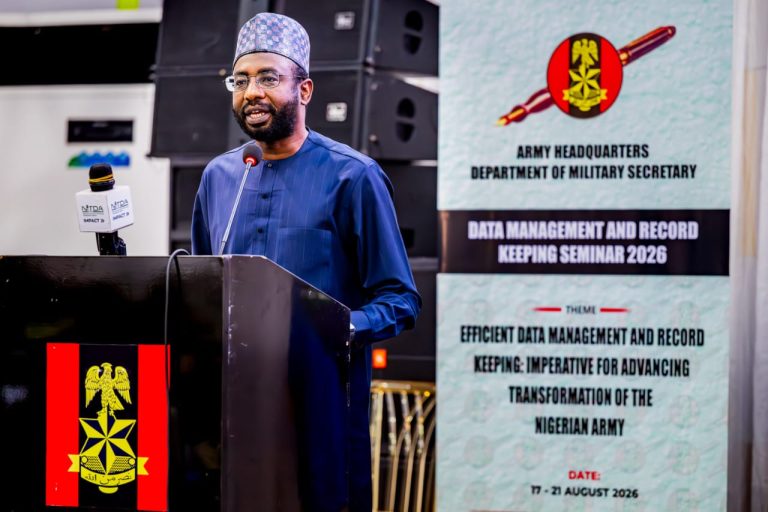
The Director-General of NITDA, Kashifu Inuwa Abdullahi, CCIE, gave the charge while delivering a keynote presentation titled, “From Data to Decision Advantage: Digital Transformation, Artificial Intelligence, and the Future of Warfare,” at a Data Management and Record-Keeping Seminar organised by the Army Headquarters Department of Military Secretary in Abuja.
Abdullahi stressed that properly managed and analysed data could provide the military with a significant operational advantage by transforming raw information into actionable intelligence.
According to him, the increasing role of technology in modern warfare makes it imperative for the Nigerian Army to rethink how it collects, manages, analyses and deploys data in support of military operations.
“Globally, the defence industry is changing due to the disruptive power of technology. So we need to look beyond just using data for record-keeping to start thinking of using data management for intelligence and strategic military operations,” he said.
The NITDA DG said Artificial Intelligence (AI) could further enhance the military’s capacity to collate, analyse, verify and apply information, thereby improving the speed and accuracy of tactical and strategic decisions.
“Today, we can use Artificial Intelligence (AI) to help us collate, analyse, verify, and apply data in our military operations. We can integrate AI to help transform data into strategic and tactical information for decision-making.
“So, it is important to rethink the way we use technology to transform our institutions. To transform an organisation, you need to take cognisance of the people, the process, and the proper technology to adopt,” he added.
Abdullahi also urged the Nigerian Army to embrace emerging technologies more broadly across its security and defence operations, describing technology adoption as a critical component of national defence readiness rather than a peripheral modernisation effort.
He further called for the development of dedicated defence digital infrastructure and data centres, noting that the military currently relies on partnerships with civilian entities in developing some technologies for defence operations.
According to him, building indigenous capacity would strengthen the country’s ability to develop and deploy technologies tailored to its unique security challenges.
“The Nigerian Army has to consider ways of collaborating with other government agencies and the indigenous tech innovation ecosystem to build defence technology that can help us defend our nation,” he said.
On capacity building, the NITDA DG emphasised the need to develop a robust digital transformation skill set within the military and continuously upgrade the digital competence of personnel.
He noted that a digitally skilled workforce would be essential for the Nigerian military to fully exploit the potential of data analytics, Artificial Intelligence and other emerging technologies for tactical and operational purposes.
Abdullahi announced that NITDA would provide training and capacity-building initiatives to equip military personnel with relevant digital skills required to operate effectively within an increasingly data- and AI-driven defence environment.
He reaffirmed the Agency’s commitment to supporting Nigeria’s national security objectives through technology, innovation and strategic digital transformation.
END

