
Odimmegwa Johnpeter/Abuja
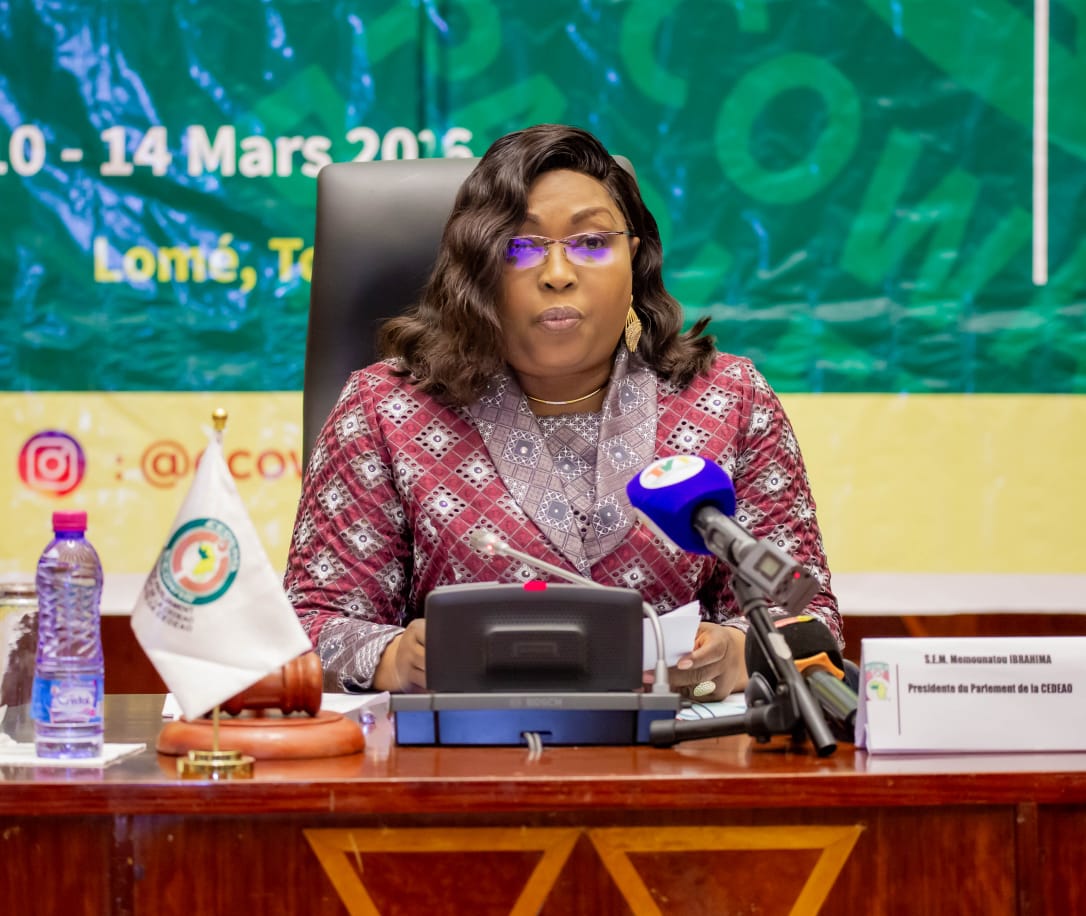
The Speaker of the Economic Community of West African States Parliament, Memunatu Ibrahima, has identified education as the cornerstone to the region’s aspiration.
Ibrahima explained that education remains a multiplier and a necessity if the sub-region will truly achieve its dream of integration.
She disclosed this at the closing of the delocalised joint meeting on the reinforcement of the curricular alignment with the socio-economic needs of the sub- region held in Lome Togo.
The meeting brought together the ECOWAS committee on Education, Science and Culture/ Committee on Health/ Committee on Telecommunications and Information Technology.
The meeting has the theme: “Strengthening Curriculum Alignment with Socio-Economic Needs of the ECOWAS Region”.
Stressing the need to prioritize education, Ibrahima said: “ If the ECOWAS intends to be more than a geographical space, if it intends to be a community in the broadest sense, then our greatest investment must be in the minds and capacities of our people. Because, after all, it is not the borders that define integration, it is the ability of our citizens to shape a prosperous future. Distinguished members, ladies, and gentlemen, today we collectively know a true fundamental truth. Our curriculum must reflect the realities of our economies.
“The future of our young population depends not only on the process of education, but also on the relevance of this education for agriculture, technology, the transformative industry, renewable energies, creative industries, entrepreneurship and regional value chains. Western Africa is a demographic enclosure, with one of the youngest populations in the world.”
Ibrahima, who was represented by the Chairman of the Joint Committee, Hon. Orlando Pereira Diaz, a member of the Cape Verdean delegation to ECOWAS Parliament, stressed, “Education continues to be the cornerstone of this aspiration because it is the great multiplier.
“It transforms competence into productivity. It converts the demographic system into economic power. Regional integration ceases to be a political theory and becomes a reality.”
She pointed out that: “The vision of ECOWAS has never been limited to political protocols or political cooperation. These instruments are important, yes, but they are not the ultimate goal. The true vision of the ECOWAS is deeper and longer-lasting, a fully integrated region driven by its people.”
ECOWAS Speaker reminded members and other dignitaries present, including students, that “regional integration is not only sustained in agreements, but also in human capacity. It is driven by sufficiently qualified citizens to compete, sufficiently innovative to solve problems, and sufficiently capable of leading the change.
“In fact, an agrarian union can facilitate trade, but only an established population can generate wealth. Political stability can provide empowerment, but only knowledge and competence can provide that empowerment with progress. When our people are qualified, our industries grow. When people are innovative, our economies diversify. When citizens are empowered, our democracies deepen.”
She also urged the ECOWAS member states to take advantage of the youthful demographic dividends to avoid the consequences of unemployment and migration..
According to her, “We must choose to take advantage of this demographic divide or risk the consequences of unemployment, migration and social instability. The alignment of curricula to the experiences of the labour market is not, therefore, a mere negative reform. It is an economic imperative and a security strategy.”
Ibrahima, therefore, pledged the support of the regional parliament to provide needed supervision and harmonisation to transform education in the sub-region.
“Distinguished members, ladies and gentlemen, in this respect, the ECOWAS Parliament remains fully committed to providing educational support, political supervision and the necessary regional harmonisation to transform our educational system. We must strengthen cooperation between governments, universities, technical institutions, private sector agents and government partners to ensure that what is taught in our schools can correspond to our objectives and to what is necessary in our economies. The organisation of qualifications between Member States will facilitate the mobility of workers.
“The investment in education, training, technical and professional will strengthen our role of fundamental competencies for superior practices. Digital literacy must become fundamental and not optional. Research and innovation must be linked to the use of digital technology.”
She also re-echoed the need to realign the educational curriculum to reflect the manpower needs of the sub-region.
“And, what is most important, our curricula must reflect the values and systems of autonomous knowledge of ECOWAS while remaining simultaneously competitive worldwide. We also recognise the importance of inclusion. Women, girls, people with disabilities, rural communities, and marginalised groups should not be left behind in this formation.
“An aligned curriculum must be inclusive. Distinguished members, ladies, and gentlemen, integration is not an abstract concept. It happens when a graduate from a Member State can contribute with confidence to the economic growth when the education developed in a country is expanded throughout the region, when education stimulates economics and economics stimulates prosperity,” she said.
The regional speaker also gave the assurance that the ECOWAS Parliament, “will continue to defend policies that shape the gap between education and employment, between theory and practice, between national ambition and regional progress.”
She therefore hoped that the meeting would not end in a mere exchange of ideas, “but in a meeting that marks the beginning of a coordinated action. We will leave here committed to measurable reforms, reinforced partnerships, and a sustainable political will.”
She concluded by sounding a warning that “the future of West Africa will not be driven by chance, it will be driven by the decisions we make today in our classrooms, in our parliaments, in our institutions and in our economies. Together, we will build a scenario in which education drives innovation. Innovation drives productivity and productivity, and it drives shared prosperity.”
END

