
Odimmegwa Johnpeter/Abuja
The Presidential Renewed Hope Media Tour has commended the National Agency for Science and Engineering Infrastructure (NASENI) for its giant strides in domestication and promotion of local technologies, describing it as evidence to Nigeria’s emerging capacity to innovate, manufacture and commercialize home-grown solutions in line with President Bola Ahmed Tinubu’s Renewed Hope Agenda. This was contained in a statement signed by Segun Ayeoyenikan, Director of Information, NASENI.
Speaking for The Presidential Renewed Hope Media team, Mr. Bayo Onanuga, Special Adviser to the President on Communication, Information and Strategy, described the NASENI tour in three words—“impressive, impressive, impressive”—saying the innovations demonstrated the capabilities of Nigerian youths for high performance when provided with purposeful leadership, institutional support and right environment.
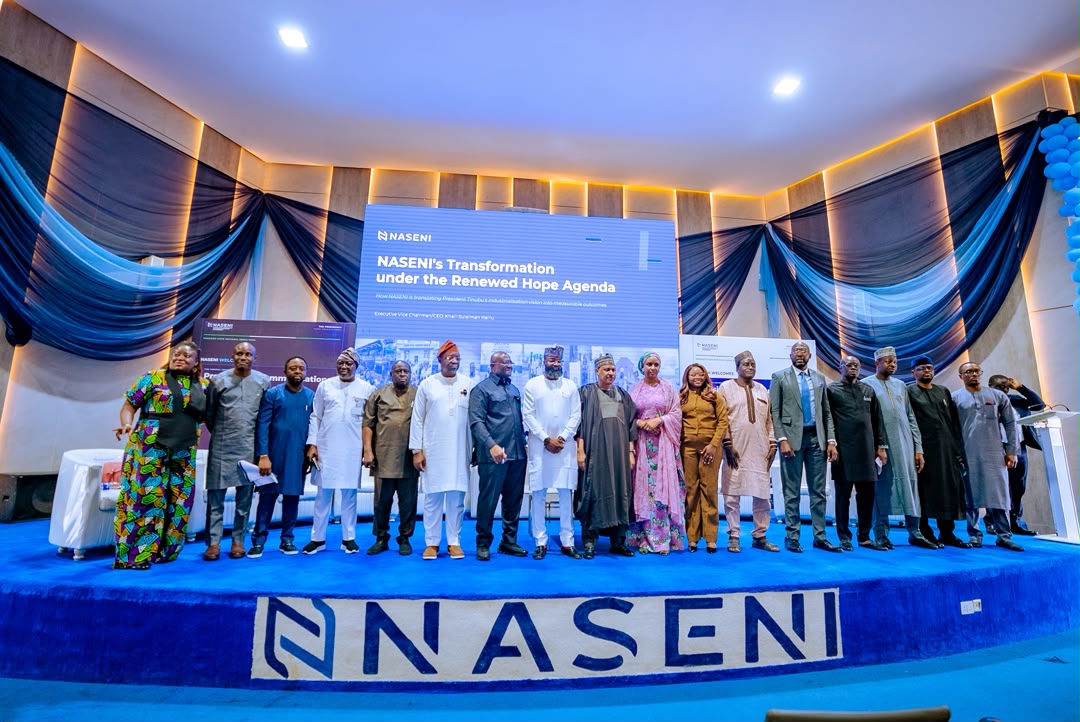
The team who was in NASENI on Tuesday 4th August 2026 as part of its Renewed Hope National Media Tour, said the Agency has been transformed within a space of three (3) years under the leadership of its Executive Vice Chairman/Chief Executive Officer, Mr. Khalil Suleiman Halilu, following his commitment and determination to change the narrative of accelerated technology transfer, adaptation domestication of foreign technologies and the promotion of home-grown technologies in Nigeria.
In his welcome address, NASENI’s Chief Executive said there was a misconception that products developed by the Agency must be 100 per cent locally made, arguing that such an approach was unrealistic in today’s global economy, sighting examples with global technology companies such as Apple which focuses on its strengths on technology development.
He stressed that countries should focus on their comparative strength, including design, innovation and strategic partnerships rather than insisting on complete local production. “If you attempt to make everything 100% local, you are pushing yourself out of civilization.
“Today, Apple is one of the biggest technology companies in the whole world because they are intentional and strategic in building on their area of strength. So, it is very important that nations understand their strength. That is what will make our business sustainable, grow and expand into other territories,” he stressed.
Halilu, however, noted that NASENI today prioritizes projects capable of creating jobs, reducing production time and to add value to the economy in line with the Nigeria First Policy, adding that the agency remains committed to pursuing innovations that could be scaled commercially and expanded into new markets.
Speaking during the engagement, the Minister of Information and National Orientation, Mohammed Idris, commended the developments at NASENI and called for stronger communication of the Federal Government’s achievements across sectors by the media. He cited government investments in renal and cancer treatment centers and other interventions as examples of progress that should be brought more effectively to the attention of Nigerians.
He stressed that while much more remains to be done, citizens should also be informed about the positive developments taking place across the country. Idris urged the media to intensify coverage of government programmes and use their platforms to promote informed public discourse, rather than allowing political differences to overshadow national development.
He said the administration of President Tinubu was determined to transform and reposition Nigeria and called on the media and citizens to support the national development effort. He also commended the Presidential Media Team for its nationwide engagements with governors, government agencies and other stakeholders aimed at bringing government achievements closer to the people.
The Special Adviser to the President on Policy and Coordination, Hajia Hadiza Bala Usman, stressed the importance of strategic communication, stronger public-sector patronage and increased visibility for Nigerian innovations.
Special Adviser to the President on Media and Public Communication, Chief Sunday Dare, described the visit as a “massive eye-opener” and called for greater awareness and stronger government support for NASENI’s programmes.
He advocated a policy requiring Ministries, Departments and Agencies (MDAs) to first determine whether products and technologies needed for their operations can be sourced from NASENI or other Nigerian manufacturers before resorting to imports, saying such a mechanism would strengthen the Nigeria First Policy and ensure that public expenditure contributes directly to domestic industrial capacity.
Senior Special Assistant to the President on Media and Publicity, Mr.Tunde Rahman, and Special Assistant to the President on Digital Media, Otega Ogra, also commended NASENI’s innovations and partnerships including locally developed electric vehicles, e-tricycles and e-bikes, home solar technologies, solar panels, cookstoves, etc, describing collaborations with private-sector partners as an effective mechanism for combining expertise and resources to deliver practical solutions.
Responding to questions on the sustainability, affordability and commercialization of NASENI technologies, Halilu said technology transfer and domestication are accompanied by after-sales support, availability of spare parts and affordability, adding that the agency works with its technology partners, manufacturers and other stakeholders to move innovations from laboratories and prototypes into actual production and the marketplace.
He disclosed that the agency screens innovators through its online platform, supports successful applicants with mentorship and links them with factories to scale their products, while its “Innovate Naija Challenge”, with a ₦500 million prize fund, is designed to identify, support and commercialize promising Nigerian innovations.
The commendations of NASENI by the Presidential Renewed Media Tour followed a comprehensive visit to NASENI facilities in Abuja by members of the Presidential Communications team, government officials, journalists and private-sector partners, during which visitors inspected innovations spanning drone technology, helicopter assembly, precision and reverse engineering facilities, agricultural technology, renewable energy, automotive technology, recycling and youth innovation.
The experience demonstrated practical application of NASENI’s 3Cs framework of Creation, Collaboration and Commercialization in advancing technology-driven industrialization. Other major technologies showcased were a fleet of locally assembled drones designed for precision flight, autonomous agricultural operations, surveillance, building washing and drone shows.
NASENI has developed surveillance drones capable of precise take-off, return and landing, while agricultural drones can be programmed for autonomous crop spraying. The Agency has also trained drone pilots, including female engineers, and is positioning its Unmanned Ariel Vehicle (UAV) training facilities to provide additional skills for government personnel, farmers and others.
At the NASENI Centre of Excellence, visitors were taken through NASENI’s advanced reverse-engineering and precision-manufacturing capabilities. A seven-axis scanner with accuracy of between two and three microns that can capture physical components and convert them into computer-aided design files, enabling engineers to reproduce products more rapidly, improve accuracy and reduce human error.
The Centre is also strengthening Nigeria’s local-content drive by reverse-engineering samples supplied by industries and subsequently producing customized moulds for mass production. The process provides local alternatives to imported components while strengthening domestic production capacity.
The facility is also implementing a zero-waste manufacturing approach by recycling scrap iron generated from its operations through an in-house furnace and converting it into new products, including horseshoes, thereby turning industrial waste into productive inputs and economic value.
Stakeholders after the tour were calling for a sustained national campaigns to promote Nigerian products, strengthen technology transfer, expand indigenous manufacturing, reduce import dependence and translate President Tinubu’s Nigeria First Policy into a Movement, while promoting his industrialization agenda from policy into measurable results.
END

