
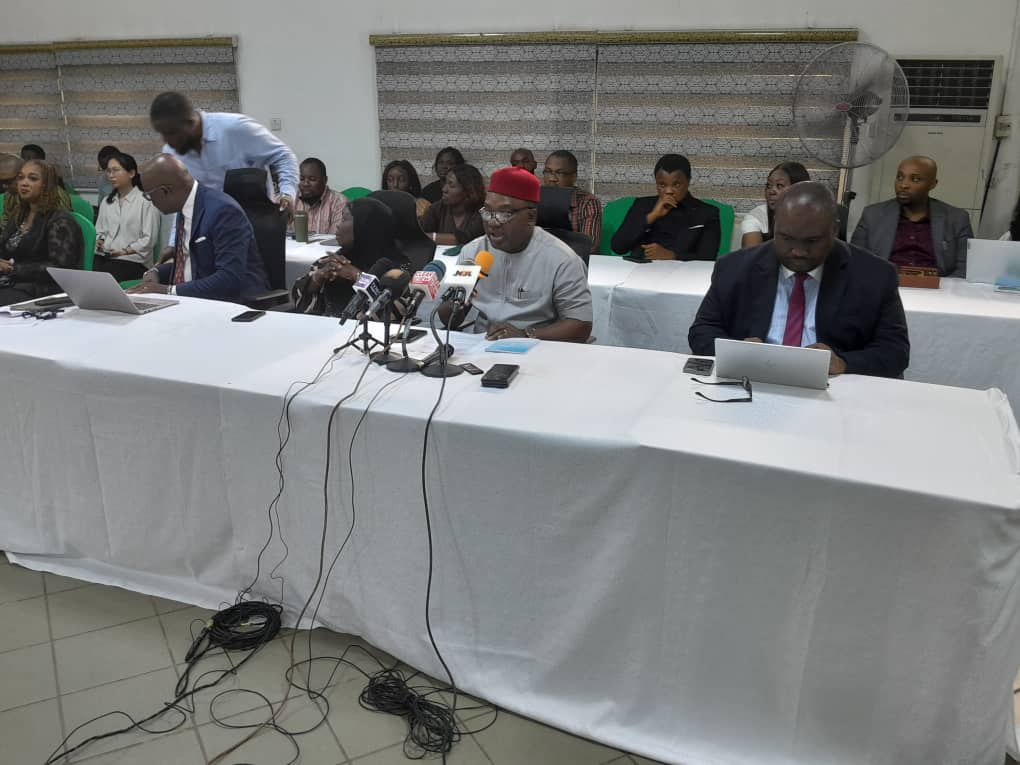
Odimmegwa Johnpeter/Abuja
The Executive Secretary of the National Human Rights Commission, Dr. Tony Ojukwu, OFR, SAN, has reiterated the commitment of the Commission to a Nigeria where no one is left behind, where discrimination fades, opportunities flourish, and dignity is non-negotiable.
Ojukwu stated this in his opening remarks at the presentation of the August 2025 Human Rights situation dashboard in Abuja.
He described the presentation of the dashboard as
“a moment to reflect, recalibrate, and renew our commitment to a Nigeria where every heartbeat carries the promise of dignity.
His words: “Today, we are not just sharing data; we are re-igniting a conversation, a movement, a shared dream of justice that echoes across our 36 states of Nigeria and beyond. Today, we present our determined efforts through in the ‘Protection of Human Rights of Forcibly Displaced Persons through Information/Data Collection and Documentation in Nigeria’ initiative, spotlighting the plights of IDPs, Returnees, Refugees and Asylum Seekers tracked from May to July 2025.
“As we gather today, let us pause to acknowledge the resilience of the Nigerian people. In the face of economic pressures, social disruptions, and security challenges, your voices continue to reach us. You report, you resist, and you remind us that human rights are not abstract ideals but the very fabric of our national life.
“In August, the National Human Rights Commission stood as a beacon of hope for Three Hundred and Sixty-Five Thousand, Two Hundred and Twenty Four (365,224) voices who entrusted us with their stories of struggle for enjoyment of human rights. These complaints, received across our 38 collection points in Nigeria, reveal a nation at a crossroad. The data speaks loudly, spotlighting three critical areas: Freedom from Discrimination, Economic, Social, and Cultural Rights (ESCR), and Law Enforcement and Human Dignity. These are not mere statistics; they are the pulse of a people yearning for fairness, justice, and respect. Our Observatory’s findings amplify this urgency, documenting incidents of human rights violations across all geo-political zones. The North-West, particularly Zamfara and Katsina, bore the brunt of banditry, with mass killings like the tragic loss of 50 worshippers in a Katsina mosque and abductions of 45 in Zamfara’s Bakura. In urban centres like FCT and Kwara, mob justice surged, with lynchings over theft and blasphemy allegations, reflecting a crisis of trust in law enforcement.
“The Observatory also highlights a distressing rise in violations against vulnerable groups. Sexual and gender-based violence targeted minors, with harrowing cases of rape against girls as young as 2 in Ekiti and 7 in Ondo. Benue and FCT reported deadly farmer-herder clashes, while land disputes fueled killings in Ebonyi. Suicides in Osun and Imo, linked to financial and academic stress, signal an urgent need for mental health support. These trends paint a stark picture. Yet, they also galvanize us to act: to strengthen child protection laws, reform policing with transparency tools, and address land tenure to curb communal violence.
He further noted:”They call for dialogues that celebrate our diversity as strength, not division. Law enforcement must lift, not oppress the citizenry to restore faith in those who serve. We must amplify anti-discrimination laws through education and enforcement, ensuring no Nigerian is judged by tribe, faith, gender, orientation, or other differentiating factors. This dashboard challenges us to bridge policy and practice, urging government at all levels to prioritize ESCR in budget allocations and implementation.
“Ladies and gentlemen, the state of vulnerable populations in Nigeria should be of great concern to governments at federal, state, and local levels. Our Dashboard on the Human Rights and Internal Displacements reveal humanitarian crises of immense proportion. Multiple factors such as raging conflicts, banditry, and climatic disasters have thrown up internal displacements impacting the human rights of poor and already traumatized populations. Our engagement with community protection action group members in the project documented 8,966 displacements between May and July and a cumulative 53,261 from February to July. These are not just mere numbers. They represent Nigerians who have been exposed to multiple human rights violations, impacting their dignity and humanity.
According to the Executive Secretary, the National Human Rights Commission, with the support of our partners, UNHCR, has also documented rising incidences of numbers of populations of returnees and refugees across our project sites. Between the months of May and July, there were a total of 10,710 Returnees to communities, 5,191 refugees, and 2.275 Asylum Seekers in the same period. These populations of persons in motion – returnees, refugees, and asylum seekers represent individuals in their highest forms of vulnerability and exposure to human rights violations.
He also said: “The NHRC continues to call on the relevant stakeholders, including governments and humanitarian organisations, to make provisions for the full enjoyments of human rights for these populations of concern. Our constitution, as well as our regional and international human rights obligations, enjoins us to protect the human rights of all without discrimination based on status or origins. We should walk the talk.
“As we engage with these dashboards, I call on all stakeholders, government, private sector, civil society, and citizens to act decisively. Let us commit to the National Action Plan on the Promotion and Protection of Human Rights: strengthening early warning systems, strengthening referral systems, scaling digital reporting tools, and fostering multi-sectoral dialogues. Our Observatory’s robust tracking, coupled with increasing trends in resolved cases, shows progress is possible. Let us build on this by expanding community custodians in hotspots like the North-West and youth-led forums in the South-East.
“Ladies and gentlemen, these dashboards continue to serve as our compasses. They point us to work for a Nigeria where no one is left behind, where discrimination fades, opportunities flourish, and dignity is non-negotiable. I call on all stakeholders to support our vision: real-time alerts, nationwide responses, and policies that breathe life into the lived experience of every Nigerian. Together, let’s strive to write a new chapter, one where this dashboard doesn’t just count complaints but celebrates solutions.
“Lastly, let me also take this opportunity to thank our state offices, partners, and civil society allies and all whose contributions continue to make this work possible. We also extend our appreciation to the United Nations High Commission for Refugees, United Nations Development Programme, and the Office of the High Commissioner for Human Rights for their support to the National Human Rights.
During his presentation of the August 2025 Human Rights Situation Dashboard, the Project Coordinator, Barr. Hillary Ogbonna stated that the Commission
has the mandate to promote and protect human rights in Nigeria,
as well as the powers to monitor, investigate, and report human rights
violations in Nigeria.
He also noted that since January 2024, NHRC, in partnership with UNDP, OHCHR, and GANHRI
has produced a monthly dashboard on human rights situation.
He further stated, “The Dashboards contain data from complaints lodged at the NHRC 38
offices across Nigeria and human rights violations monitored through
NHRC Human Rights Observatory.
“NHRC Dashboard has presented situational data on the rights of children,
women and other vulnerable populations
The dashboard also revealed that
• Human rights complaints to the NHRC increased
marginally in the month of August.
• Increased violence and killings in the middle belt
– Benue and Plateau.
• Katsina recorded the highest fatalities in the
month
• Physical and Sexual Violence on Children
• Increase in the killings of military, law
enforcement and security agencies
NHRC August 2025
Human Rights Complaints
• Total Number of
Complaints: 365,224
[An increase of 10%
compared to June-July
2025].
August 2025 Complaints Across Geo-Political Zones
The geopolitical zone with the highest number of complaints in the month of
August 2025 is North Central with 152,870, while the lowest is South West geopolitical zone with 13,864 complaints.
Top 10 States for NHRC complaints August 2025 were; Benue. Borno, NHRC HQ, Kaduna, Niger, Plateau, Imo, Sokoto, Kogi, Enugu, Bauchi.
The distribution across geopolitical zones for August 2025 indicates that North Central has the highest percentage of 42%, North East 19%, North West 19%, South East with 12%, South South has 4% as well as 4% for South East.
The dashboard of August 2025 regards the violation of children’s rights shows child trafficking as the most violated children’s rights while access to education is the least.
Kidnapping cases is 450, Killings-306, child abandonment-386, Killing of Armed forces & law enforcement-14
Sexual and gender based violence shows sexual violence is 322, while domestic violence is 2981 and rape is 17.
NHRC also expressed its gratitude to the United Nations Development Programme, the Office of the High Commissioner for Human Rights, and GANHRI for their support to the Tripartite Partnership Programme.
END

