
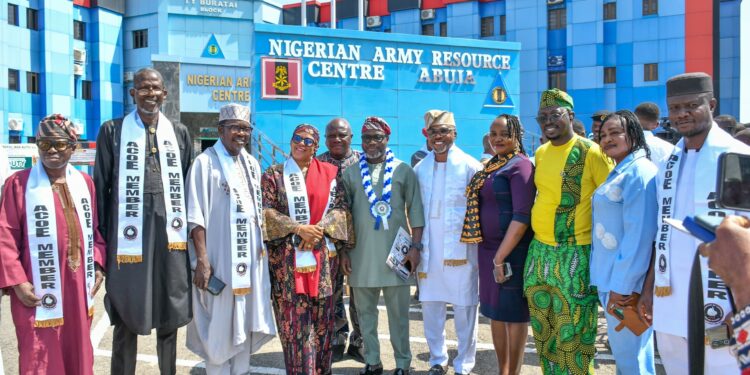
Theme: Roadmap to 2027: Strengthening Electoral Security Through Collaboration Between INEC, the Media and Political Parties for Credible and Hitch-Free Elections
Date: Thursday, 19 November 2026
Venue: Army Resource Centre, Asokoro, Abuja, Nigeria
The Association of Corporate Online Editors (ACOE), at its 2026 Annual Lecture and Awards held on Thursday, 19 November 2026, in Abuja, reaffirmed its commitment to professionalism, ethical journalism, responsible self-regulation, national cohesion and the promotion of credible electoral processes ahead of the 2027 general elections.
The conference, themed “Roadmap to 2027: Strengthening Electoral Security Through Collaboration Between INEC, the Media and Political Parties for Credible and Hitch-Free Elections,” brought together representatives of electoral institutions, government agencies, media organisations, political stakeholders, education sector representatives and other participants to examine the role of credible information, institutional collaboration and responsible political conduct in safeguarding Nigeria’s democracy.
Following deliberations and goodwill messages from stakeholders, the Association made the following observations, recommendations and commitments:
1. Electoral Security Is a Collective Responsibility
The conference noted that electoral security extends beyond the physical protection of polling units, electoral materials and personnel to include information security, public trust, institutional accountability and the prevention of violence, intimidation and misinformation.
It observed that the credibility and peaceful conduct of the 2027 general elections require sustained collaboration among the Independent National Electoral Commission (INEC), political parties, security agencies, the media, civil society organisations, government institutions and the electorate.
The conference emphasised that no single institution can independently guarantee credible and peaceful elections without the cooperation and commitment of other stakeholders.
2. Commitment to Professionalism, Ethical Journalism and Responsible Self-Regulation
The conference reaffirmed the importance of professionalism, accuracy, fairness, balance, fact-checking, accountability and ethical editorial judgment in Nigeria’s digital media industry.
It expressed concern over the growing proliferation of unverified reports, misleading headlines, fabricated stories, impersonation of journalists and the publication of information without adequate verification or editorial oversight.
The conference noted that the unrestricted access to digital publishing platforms has increased the responsibility of professional media organisations to distinguish credible journalism from unverified content and sensationalism.
It therefore reaffirmed ACOE’s commitment to promoting responsible self-regulation through professional standards, peer review, editorial accountability, capacity building and ethical guidelines.
The conference stressed that self-regulation should serve as a mechanism for strengthening public trust and media credibility and should not be misconstrued as an instrument for suppressing freedom of expression or independent journalism.
3. Combating Misinformation, Disinformation and Digital Manipulation
The conference recognised misinformation, disinformation, deepfakes, synthetic media, manipulated videos, cloned voices, automated amplification and coordinated information manipulation as growing threats to electoral security and democratic stability.
It noted that the spread of false electoral information, including fabricated polling unit relocation notices, manipulated election footage, false declarations of results and misleading narratives about electoral procedures, could trigger confusion, voter suppression, distrust and violence.
The conference urged online media organisations and journalists to strengthen verification procedures, authenticate digital materials, establish reliable sourcing mechanisms and avoid publishing unverified information capable of misleading citizens or heightening political tensions.
It further encouraged media organisations to provide context, promptly correct inaccurate reports and prioritise verified information from credible and authoritative sources, particularly during sensitive electoral periods.
4. Strengthening Collaboration Between INEC, the Media and Political Parties
The conference called for stronger, sustained and institutionalised collaboration between INEC, the media, political parties and other electoral stakeholders before, during and after elections.
It encouraged regular engagement, timely information sharing, transparent communication and constructive dialogue to address emerging electoral concerns, clarify procedures and prevent avoidable misinformation.
The conference stressed that electoral institutions should maintain accessible, timely and transparent communication channels with the media and the public, particularly on voter registration, accreditation, polling arrangements, result management, electoral guidelines and other critical developments.
It also urged political parties to engage constructively with electoral institutions and the media, respect established electoral procedures and promote peaceful democratic participation.
5. Peaceful Political Campaigns and Responsible Conduct by Political Parties
The conference called on political parties, candidates, political actors and their supporters to conduct campaigns in accordance with the Constitution, electoral laws and democratic principles.
It condemned political violence, voter intimidation, harassment of journalists, attacks on electoral personnel, destruction of electoral facilities, hate speech and the use of thugs or other unlawful means to influence electoral outcomes.
The conference urged political parties to promote issue-based campaigns, respect opposing views, discourage inflammatory rhetoric and exercise discipline among their supporters.
It emphasised that political competition should be driven by policies, ideas, programmes and public interest rather than ethnic, religious, regional or other divisive sentiments.
The conference further encouraged political parties and candidates to honour peace agreements, respect the rights of voters and electoral officials, and channel grievances through lawful and constitutional processes.
6. Security Agencies and Protection of the Electoral Process
The conference acknowledged the critical role of security agencies in protecting voters, electoral officials, journalists, election materials, polling facilities and other vulnerable stakeholders throughout the electoral process.
It called for effective inter-agency coordination, intelligence sharing, professional conduct, neutrality and timely response to security threats.
The conference emphasised that the deployment and conduct of security personnel during elections must be guided by the law, respect for human rights, impartiality and the protection of citizens’ democratic rights.
It urged security agencies to work closely with INEC, political parties, the media and civil society organisations to identify and address threats capable of undermining peaceful elections.
7. Civic Education, Voter Awareness and National Cohesion
The conference recognised the importance of an informed, politically conscious and responsible electorate in sustaining democratic participation and electoral credibility.
It commended the National Orientation Agency (NOA) for its civic education, public enlightenment, sensitisation and advocacy efforts aimed at promoting peaceful electoral participation, national unity and respect for democratic institutions.
It urged the intensification of voter education on electoral rights and responsibilities, voting procedures, peaceful participation, rejection of vote-buying, tolerance of divergent political views and the importance of protecting the integrity of the electoral process.
The conference encouraged citizens to seek information from credible sources, resist manipulation and refrain from sharing unverified information capable of inciting violence or undermining public confidence.
8. Media Responsibility in Promoting National Unity and Democratic Stability
The conference urged media organisations to exercise greater editorial responsibility in reporting political, ethnic, religious and regional issues, particularly as the country approaches the 2027 general elections.
It warned against the deliberate amplification of inflammatory statements, divisive narratives, hate speech and sensational content for traffic, engagement or commercial gain.
The conference stressed that responsible journalism must promote informed public debate, accountability, national cohesion and peaceful coexistence without compromising the media’s constitutional responsibility to scrutinise public institutions and hold leaders accountable.
It encouraged editors to balance the media’s watchdog role with the responsibility to avoid narratives that could endanger lives, deepen divisions or destabilise the democratic process.
9. Recognition of the Role of Teachers and Education in National Development
The conference acknowledged the indispensable contribution of teachers and the education sector to national development, citizenship formation, character building and the promotion of democratic values.
It noted that the quality of education and the welfare, preparation and professional development of teachers have significant implications for the country’s future.
The conference therefore called on government, policymakers and relevant stakeholders to prioritise teachers’ welfare, capacity development, professional recognition and the strengthening of the education system.
It also urged the media to give sustained attention to education, teacher development and policies that contribute to national growth and social transformation.
10. Strengthening ACOE’s Institutional Capacity and Industry Collaboration
The conference reaffirmed ACOE’s commitment to strengthening its institutional capacity, promoting professional development among corporate online editors, advancing ethical standards and fostering constructive engagement with government institutions, corporate organisations, civil society, media stakeholders and development partners.
It encouraged greater collaboration and knowledge sharing among members, continuous training in digital journalism, election reporting, fact-checking, misinformation detection, newsroom management, investigative journalism and emerging technologies.
The conference further emphasised the need for online media organisations to adopt credible editorial structures, transparent professional practices and accountability mechanisms that will strengthen public confidence in the digital media ecosystem.
It noted that the growth and sustainability of digital journalism depend not only on technological innovation and audience reach but also on credibility, integrity and public trust.
11. Institutional Engagement and Partnership for Democratic Development
The conference called for deeper partnerships among ACOE, INEC, NOA, NIMC, security agencies, educational institutions, civil society organisations, political parties, media organisations and development partners.
It encouraged stakeholders to move beyond ceremonial engagements towards practical collaborations, including joint civic education initiatives, electoral awareness campaigns, professional training, information verification mechanisms, media capacity development and public-interest communication.
The conference stressed that collaborative initiatives should be sustained, inclusive and geared towards promoting peaceful elections, credible information, democratic accountability and national development.
12. ACOE’s Commitment Ahead of the 2027 General Elections
The Association of Corporate Online Editors reaffirmed its resolve to use its collective professional influence to promote responsible journalism, credible information, peaceful political participation, democratic accountability and national development.
ACOE pledged to encourage its members to uphold the highest standards of editorial professionalism, verify information before publication, avoid the spread of misinformation, promote balanced reporting and provide citizens with reliable information necessary for informed democratic choices.
The Association also committed to strengthening engagement with relevant institutions and stakeholders in support of a peaceful, credible and inclusive electoral process in 2027.
RESOLUTIONS
After deliberations, the conference resolved as follows:
1. To reaffirm ACOE’s commitment to professionalism, ethical journalism, accuracy, fairness, accountability and responsible self-regulation in Nigeria’s digital media industry.
2. To promote sustained collaboration between INEC, the media, political parties, security agencies, civil society organisations and other stakeholders towards peaceful, credible and inclusive elections.
3. To encourage online media organisations to strengthen fact-checking, source verification, editorial oversight and responsible reporting, particularly in the coverage of electoral activities.
4. To reject the publication and amplification of misinformation, disinformation, manipulated digital content, hate speech and inflammatory narratives capable of undermining electoral security and national cohesion.
5. To call on political parties, candidates and their supporters to embrace issue-based campaigns, peaceful political competition, tolerance and respect for the rule of law.
6. To urge security agencies to maintain professionalism, impartiality, effective coordination and respect for human rights in the discharge of their electoral responsibilities.
7. To support expanded civic and voter education initiatives aimed at promoting citizens’ awareness of electoral rights, responsibilities, voting procedures and peaceful participation.
8. To encourage stronger media engagement with electoral institutions and relevant stakeholders through timely information sharing, open communication and constructive dialogue.
9. To strengthen ACOE’s capacity for professional development, digital journalism training, election reporting, fact-checking, misinformation detection and editorial accountability.
10. To promote national cohesion and democratic stability through responsible reporting that prioritises verified information, public interest and peaceful coexistence.
11. To deepen partnerships with government agencies, corporate institutions, development partners, civil society organisations and professional bodies in advancing credible journalism and democratic development.
12. To reaffirm that the protection of democracy, electoral integrity, national peace and the public interest is a shared responsibility requiring the commitment of all stakeholders.
APPRECIATION
The Association of Corporate Online Editors expresses its profound appreciation to the Independent National Electoral Commission (INEC), the National Orientation Agency (NOA), the National Identity Management Commission (NIMC), the National Commission for Colleges of Education (NCCE), security institutions, political stakeholders, media organisations, development partners, invited guests, members, award recipients and all participants for their contributions to the success of the 2026 Annual Lecture and Awards.
The Association particularly appreciates the contributions and goodwill messages of stakeholders who reinforced the importance of credible information, responsible journalism, civic education, national unity, electoral security and professional standards in the digital media industry.
ACOE also commends its members, partners and supporters for their continued commitment to the growth of the Association and the advancement of responsible online journalism in Nigeria.
The conference recognises that the credibility of the 2027 general elections and the stability of Nigeria’s democracy will depend significantly on the willingness of institutions, political actors, media practitioners and citizens to act responsibly, collaboratively and in accordance with the law.
The Association therefore calls on all stakeholders to translate the discussions, recommendations and commitments of the 2026 Annual Lecture and Awards into sustained action in the months leading to the 2027 general elections.
Issued by the Association of Corporate Online Editors (ACOE)
Abuja, Nigeria
19 November 2026

