
Odimmegwa Johnpeter/Abuja
The Federal Government has allayed the fears of the organised labour over the new National Industrial Relations Policy (NIRP) 2025, recently approved by the Federal Executive Council (FEC). This was contained in a statement signed by Patience Onuobia, Head, Information, and Public Relations.
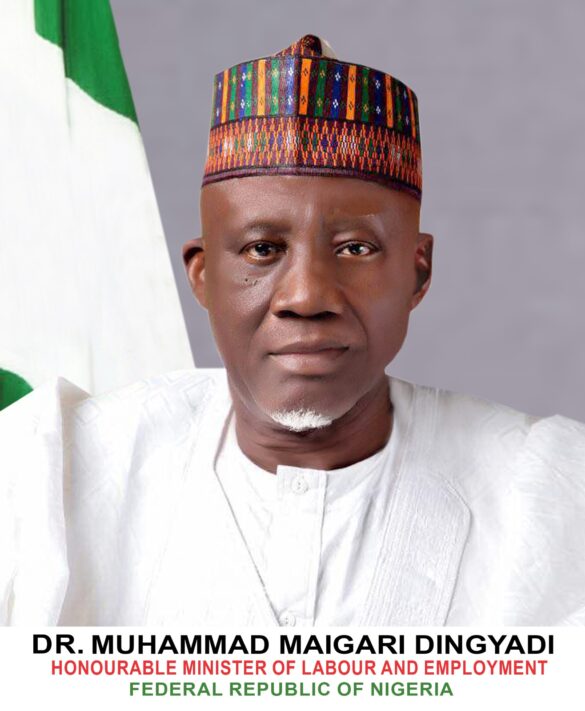
Speaking on Friday, the Minister of Labour and Employment, Muhammad Maigari Dingyadi, assured that the new NIRP would bring numerous benefits to Nigeria, such as improved industrial harmony, enhanced productivity, and protection of workers’ rights.
Dingyadi gave this assurance while reacting to the rejection of the new NIRP by the organised labour, which considered the policy an attempt to criminalise strikes and silence the labour unions, as reported in the media.
The Minister noted that the policy is the culmination of several engagements of Government, represented by Federal Ministry of Labour and Employment, organised labour, represented by the Nigeria Labour Congress (NLC) and Trade Union Congress (TUC), and employers, represented by the Nigeria Employers Consultative Association (NECA).
According to Dingyadi, these engagements spanned nearly seven years, and the final draft of the NIPR policy was validated by the stakeholders in December 2024.
He highlighted the benefits of the policy to Nigeria, including improved industrial harmony by reducing industrial disputes and promoting stable labour relations nationwide, leading to more predictable, peaceful, and structured labour relations across sectors.
The Minister explained that by ensuring smooth workplace operations and strengthening tripartite cooperation between government, employers, and workers, the policy is projected to boost productivity and strengthen investor confidence in Nigeria’s labour environment.
He expressed high optimism that the policy will align Nigeria’s industrial relations practices with global benchmarks, particularly those of the International Labour Organization (ILO), making the country more competitive and attractive to domestic and foreign investments.
Speaking further, Dingyadi posited that the policy would lead to enhanced social dialogue, since it emphasises the importance of social dialogue in resolving conflicts and building consensus among stakeholders, including regular consultations and negotiations between government, employers, and trade unions.
He said: “The NIRP ensures the protection of workers’ rights, including fair wages, safe working conditions, and the right to collective bargaining, while also addressing issues like gender equality and non-discrimination.
The Minister stated that the policy would serve as a reference point for labour laws, union engagement, and conflict resolution in both public and private sectors, promoting more effective labour relations.
END

