
Odimmegwa Johnpeter/Abuja
The Federal Government has said the economic reforms introduced by President Bola Ahmed Tinubu’s administration have saved Nigeria from plunging deeper into economic crisis while acknowledging that poverty and household welfare remain major areas requiring urgent attention.
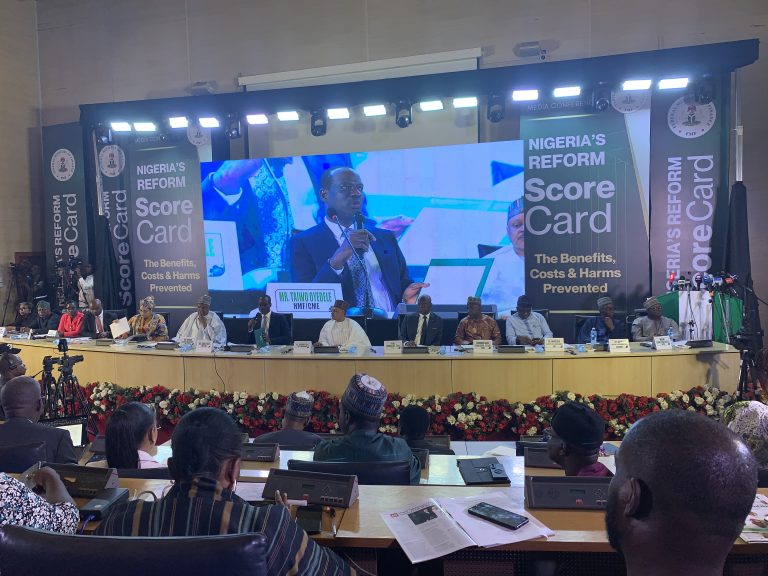
The Honourable Minister of Finance and Coordinating Minister of the Economy Taiwo Oyedele stated this while presenting the government’s “Nigeria’s Reform Scorecard: The Benefits, Costs & Harms Prevention” at a media conference organised by the Federal Ministry of Finance. According to Oyedele, the removal of fuel subsidy and unification of the foreign exchange market had imposed significant costs on Nigerians but had also created fiscal space and prevented potentially more severe economic dislocation.
The Minister said the scorecard was not designed as a “victory lap” but as an account of what the reforms had cost, delivered and prevented. According to him, the assessment compares Nigeria’s economic position in May 2023 with its current position and a counterfactual estimate of where the country could have been without the reforms.
His words: “We invited you here today not to declare a victory, but to give an account,” he said. “What we want to do today is put the whole picture in front of you, the Nigerian people—what those reforms cost, what they delivered, and just as importantly, what they prevented.”
According to the presentation, subsidy savings and the effects of foreign-exchange reforms generated ₦15.8 trillion in additional resources for the Federation between June 2023 and December 2025. Of this amount, the Federal Government’s share was put at ₦5.4 trillion, while ₦10.4 trillion accrued to states and local governments through the Federation Account.
He further noted that the Federal Government generated an additional ₦3.1 trillion in independent revenue, while incremental borrowing during the period amounted to ₦11.9 trillion. Altogether, the government said its incremental resources stood at approximately ₦20.4 trillion.
The Minister explained that the resources were deployed alongside existing revenues to meet critical expenditure obligations, including wage adjustments, external debt servicing and infrastructure development. Of the reported ₦30.64 trillion in incremental Federal Government expenditure, ₦9.39 trillion went into wage adjustments, minimum wage increases and allowances for public servants, ₦9.37 trillion into external debt servicing, while ₦6.5 trillion was committed to strategic infrastructure.
“The incremental amount that the Federal Government spent paying higher wages is more than the entire savings that the Federal Government earned from subsidy removal,” he said, arguing that the development demonstrated improved public financial management rather than an attempt to introduce the reform merely to raise revenue.
The scorecard assessed 25 economic indicators across five broad areas, including fiscal sustainability, external stability, investment climate, social impact, growth and productivity. It compared the May 2023 baseline with the latest available data and a projected “no-reform” scenario.
The government said the exercise was intended to demonstrate not only what had happened to prices and economic indicators since the reforms began, but also what could have happened if the previous subsidy regime, multiple exchange rates and heavy reliance on deficit financing had continued.
On the social impact of the reforms, the presentation highlighted the reported improvement in states’ ability to meet salary and pension obligations, the increase in the national minimum wage from ₦30,000 to ₦70,000, student loans benefiting more than 1.5 million students, cash transfers to vulnerable households, subsidised mortgages and agricultural interventions.
The government also pointed to improvements in inflation and other macroeconomic indicators. It said headline inflation had fallen to 15.91 per cent, compared with a May 2023 baseline of 22.41 per cent, while food inflation had also eased. Gross foreign reserves were put at $52.5 billion, while net reserves were said to have risen from roughly $3 billion to $34.8 billion.
The presentation further stated that the Nigerian stock market’s capitalisation had increased from approximately ₦31 trillion to ₦150 trillion, while real GDP growth had strengthened to 3.89 per cent, compared with a baseline of 2.31 per cent.
The government also cited Nigeria’s reported exit from international financial monitoring and compliance lists and an upgrade of the country’s sovereign credit rating by S&P Global as evidence of improving confidence in the Nigerian economy.
However, the Minister acknowledged that the improvements in macroeconomic indicators had not yet translated sufficiently into improved living conditions for every Nigerian.
“On food and household welfare, our assessment is candid. This remains work in progress,” he said. “Poverty and household welfare recovery is still classified in our own scorecard as unfinished business, not a victory lap.”
He said the next phase of the reform programme would therefore focus on translating macroeconomic stability into tangible relief for households through expanded social protection, agricultural interventions and improved public spending.
The government also warned of the potential consequences it believed Nigeria would have faced had the previous economic trajectory continued, including severe foreign exchange shortages, inability to sustain fuel imports and widespread salary arrears.
According to the presentation, the parallel-market premium over the official exchange rate, which was previously above 60 per cent, had fallen to below five per cent. The government estimated that without the reforms, the premium could have exceeded 150 per cent.
The Minister said the country could also have faced a situation where petrol remained officially priced at the old subsidised rate but became virtually unavailable, forcing consumers into a black market where prices could have risen to as much as ₦3,000 per litre.
“It will still be 185 naira per liter. It will not be available at the official price. And it’s likely to be trading in the black market for at least 3,000 naira per liter,” he said, describing such a scenario as an additional cost of scarcity “with nothing gained in return.”
Looking ahead, the government said it would maintain the reform trajectory while intensifying efforts to improve accountability, fiscal management, tax administration, investment predictability and household welfare.
It said the medium-term objective was to drive inflation towards single digits without returning to what it described as the “distortionary subsidy” regime, while maintaining a unified and predictable foreign exchange market.
The government also plans to expand cash transfers to vulnerable Nigerians, deepen agricultural interventions aimed at reducing food prices and work with state and local governments to ensure that the benefits of economic growth reach communities across the country.
The Minister concluded by urging Nigerians to engage constructively with the reform process and verify the data underpinning the scorecard.
“We are not here to pretend these reforms were painless. We are here to show you honestly, and with the numbers, what it cost, the benefit they delivered, and the harm that they prevented.”
Earlier, welcoming participants to the press conference, the Minister of Information and National Orientation, Mohammed Idris, said the briefing was convened to provide Nigerians with factual information on the savings and resources arising from fuel subsidy removal.
Idris described the subsidy removal as one of the most significant and difficult economic decisions taken by the administration, acknowledging that it had imposed sacrifices on households, businesses and communities.
“Citizens have a right to know the financial implications of major economic decisions taken on their behalf. They have a right to know what resources have been freed up, what these resources mean for the federation, and how the benefits of these reforms are being translated into tangible improvements in their lives,” he said.
The minister said transparency and accountability were essential to sustaining public confidence in the reform programme, stressing that government’s responsibility extended beyond announcing policies to explaining them and accounting for their outcomes.
He also urged the media to report government policies accurately while continuing to exercise its constitutional responsibility to scrutinise and criticise government.
“As the fourth estate of the realm, you have the great responsibility to critique government policies and programs. But in doing so, we must remember as always that we have a nation to keep,” Idris said.
He urged journalists to communicate government programmes and policies responsibly, saying the media had a critical role in promoting national cohesion while holding public officials accountable.
“It is not about tearing down, it is about building our nation,” he added, while welcoming journalists to what he described as an opportunity for “a very robust and insightful discussion.”
In a context-setting closing remark following the main economic reform scorecard presentation, the Hon. Minister of Budget and National Planning, Atiku Bagudu explains the rationale behind President Bola Ahmed Tinubu’s reform choices, particularly the sequencing of reforms, revenue mobilisation, investor confidence, infrastructure, security and federalism.
He argued that the reforms should not be judged solely by immediate hardship or individual prices, but also by the structural problems the administration inherited and the longer-term objective of creating a stronger fiscal and economic foundation.
He said President Tinubu therefore campaigned on the Renewed Hope Agenda with a clear understanding that Nigeria was not where it wanted to be and would require bold decisions to reverse the trend.
“Mr. President was very clear that we have to confront that reality without blaming anybody. Whoever does right doesn’t matter, but how do we, and therefore we have to take choices, bold, courageous,” he said.
According to him, the administration’s first major priority was to “stop the bleeding” caused by fuel and foreign exchange subsidies, which he said were draining public resources while undermining confidence in the Nigerian economy.
“These policies were not just limiting government revenue, even bankrupting us, they have led to a lack of confidence in the economy by those who hold capital. So those who hold wealth are not enthusiastic about their money in our country,” he said.
He said the administration afterward is focused on restoring confidence among investors and other capital holders by implementing reforms designed to create a more predictable economic environment.
He further disclosed that the government inherited more than $6 billion in unpaid petroleum-import obligations, despite the country’s inadequate foreign exchange reserves.
“… inherited over six billion dollars of unpaid petroleum imports, and we don’t even have the foreign exchange. So actually NNPC was borrowing money to import. That’s how ridiculous it was,” he said.
He said President Tinubu responded by approving a crude-for-naira policy, aimed at supporting domestic economic activity and demonstrating the administration’s confidence in Nigerians and investors willing to commit capital to the country.
“Mr. President approved a crude Naira for crude policy just to ensure that the automotive binary works, just further demonstrating his commitment that those who believe in Nigeria will be supported by this administration,” he said.
Beyond fiscal and monetary reforms, Bagudu said the administration had identified security, human capital development and infrastructure as critical priorities.
He explained that the government had continued investing in these areas despite fiscal constraints, while also implementing measures to cushion Nigerians affected by the economic reforms.
On the country’s fiscal position, he said Nigeria’s revenue-to-GDP ratio was already improving, although it remained below the level the government considered desirable.
He stressed that the removal of fuel subsidy alone could not generate sufficient resources to meet Nigeria’s enormous development needs.
“Many people thought, okay, as the Honourable Minister has spoken about it, if we remove subsidies, you should have enough revenue. No. We were nowhere near where we want to be even with revenue, with subsidy withdrawal. That’s why we have to continue to deepen the reforms,” he said.
He therefore appealed to Nigerians and stakeholders to support efforts to improve domestic revenue mobilisation, arguing that a stronger revenue base would improve government capacity while also strengthening confidence among investors.
Also linked the government’s economic strategy to the principle of equity and federalism, saying President Tinubu had remained committed to ensuring that all levels and units of government were able to function effectively.
He cited the President’s participation in the National Economic Council as part of efforts to promote cooperation between the Federal Government and the states.
According to him, the administration was encouraging states to prioritise minimum levels of spending on security, infrastructure and grassroots development while pursuing measures to strengthen economic growth.
Noting infrastructure and security investments being spread across the country’s six geopolitical zones because national development could not be achieved without adequate connectivity and cooperation among the different parts of the federation.
“The choice of investment in infrastructure and security benefits all parts of Nigeria,” he said.
He added that the savings generated through the reforms, alongside borrowing, were being channelled into projects across the six geopolitical zones, insisting that the objective was to strengthen the federation as a whole.
“As we speak, these savings, this borrowing, is being invested in projects across the six geopolitical zones, and they can only be for the betterment of our Federation,” he said.
He noted that the context was important in evaluating the economic reform scorecard presented by the Minister of Finance and Coordinating Minister of the Economy, arguing that the reforms should be viewed not only through their immediate costs but also through the structural challenges they were designed to address.
END

