
Odimmegwa Johnpeter/Abuja
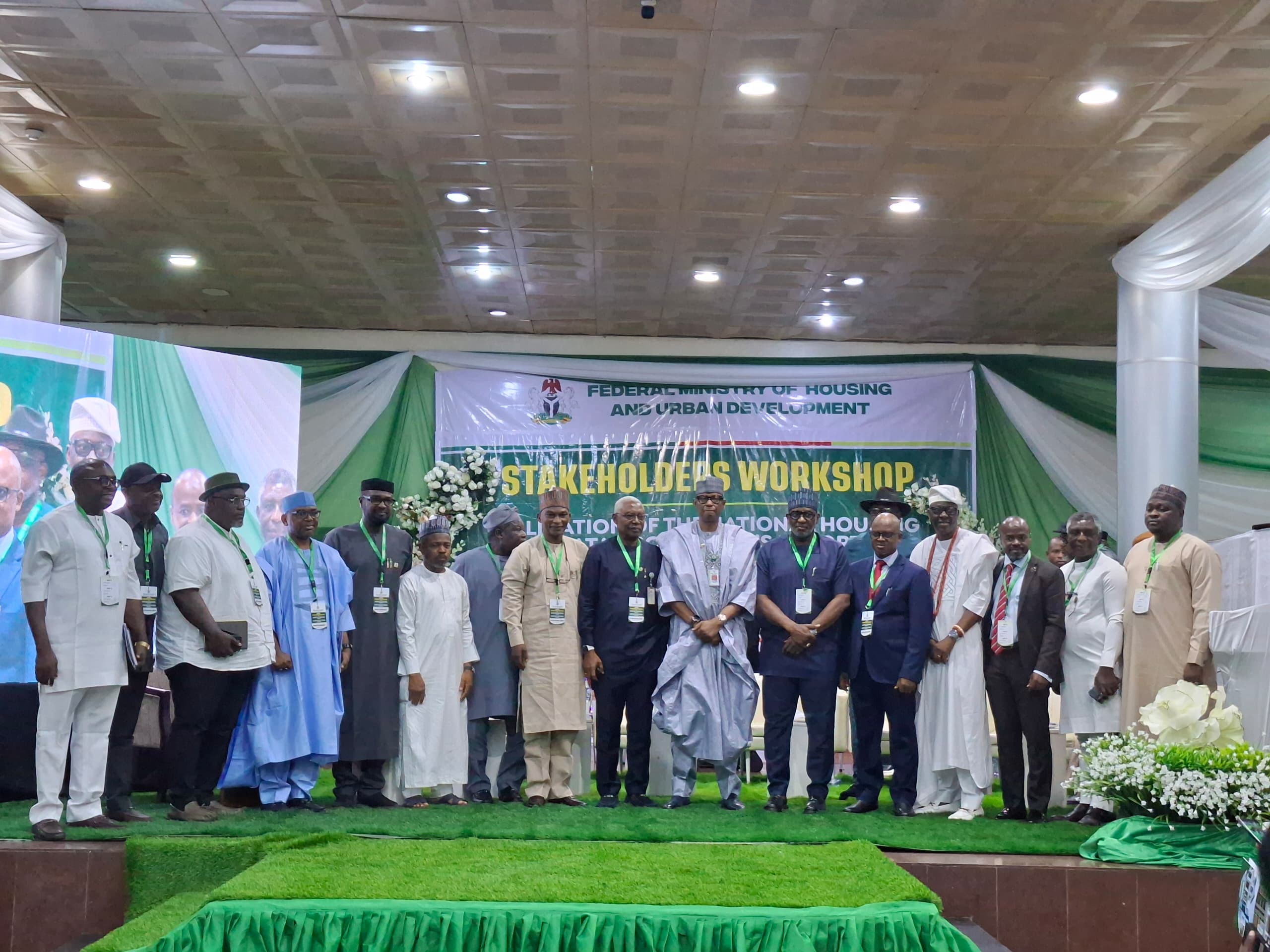
The Federal Government has convened key stakeholders in Nigeria’s housing and built environment sector to validate two landmark policy documents aimed at strengthening the regulation of the built environment, establishing a credible national housing data system, and advancing reforms that will reposition the housing sector for sustainable growth. This was contained in a statement signed by Badamasi S. Haiba, Fsca, mnipr, Director, Press, and Public Relations.
In his keynote address at the event, Minister of Housing and Urban Development, Engr. Dr. Muttaqha Rabe Darma, PhD, stated that the workshop was the final opportunity for stakeholders to shape the policies before they were presented to the Federal Executive Council (FEC).
The stakeholders are drawn from Federal and State Governments, the World Bank, the National Population Commission (NPC), the National Bureau of Statistics (NBS), the Central Bank of Nigeria (CBN), regulatory and professional bodies, financial institutions, developers, academia and the media.
“This gathering is not a ceremony. It is the last door these policies pass through before the Federal Executive Council. What you say here will change what I carry to the Council. I am not asking for applause. I am asking you to be critical,” the Minister stated.
Engr. Darma observed that Nigeria’s housing sector has grown into one of the country’s biggest economic drivers but continues to operate without an effective regulatory framework.
He noted that following the rebasing of the nation’s economy, real estate services alone account for about 13.4 per cent of Nigeria’s Gross Domestic Product (GDP), representing approximately ₦41 trillion, and together with construction, contributed over ₦77 trillion to the economy in 2025.
Despite the sector’s enormous economic value, he lamented that millions of Nigerians remain vulnerable to fraudulent housing transactions, failed developments, and poor consumer protection.
Using Dubai as an example, the Minister explained that the emirate’s introduction of compulsory escrow accounts in 2007 and the licensing of developers and agents through its regulatory authority had built the trust that allowed it to record over 270,000 property transactions worth about $250 billion in 2025 alone.
According to him, Nigeria must embrace similar reforms to protect homebuyers, attract investment, and improve standards across the built environment.
Engr Darma expressed concern over the recurring incidence of building collapse and the country’s weak mortgage system, noting that although millions of Nigerians contribute to the National Housing Fund annually, access to affordable mortgages remains extremely limited.
He explained that the proposed National Housing and Built Environment Regulation Policy seeks to introduce licensing for developers and estate agents, escrow protection for buyers’ funds, improved professional standards and construction quality, better land administration, urban renewal without displacement, and the establishment of a National Housing Data Observatory.
He said the policy also proposes the establishment of a National Housing Industry Regulatory Commission to strengthen oversight of the housing sector nationwide.
Accordingly, the Minister explained that the proposed National Mortgage Industry Policy would establish a National Housing Finance Authority, reform the FMBN, expand NHF access to workers in the informal sector and create a stronger framework for diaspora housing investment.
On housing data, Engr. Darma said the Technical Committee adopted internationally recognised methodologies, including the World Bank Adequate Housing Index and the UN-Habitat Household Crowding Index, to arrive at a core national housing deficit of about 15 million housing units.
He urged stakeholders to rigorously scrutinise the methodology during the workshop, noting that credible housing data is fundamental to effective planning, policy formulation, and investment decisions.
The Minister further called on participants to engage openly and constructively in shaping policies that would lay the foundation for a more efficient, better-regulated, and globally competitive housing industry in Nigeria.
Earlier in his welcome address, the Permanent Secretary Ministry, Dr. Shuaib Belgore, who chairs the 13-member National Housing Data Steering Committee, said the workshop was convened to validate two critical initiatives: the National Housing Data Programme and the Regulation of the Built Environment.
He acknowledged that fragmented data and weak regulatory enforcement have over the years constrained effective planning, investor confidence, and housing quality in Nigeria.
He therefore urged participants to work collectively towards strengthening the sector through reliable data and effective regulation.
In his goodwill message, the Chairman, House of Representatives Committee on Regional Planning and Urban Development, Hon. Dr. Awaji-Inombek Abiante stressed the need for reliable, homegrown housing data to tackle Nigeria’s housing challenges, noting that effective planning and meaningful reforms can only be built on accurate information.
While stating that housing reforms must improve the lives of all Nigerians, not just a privileged few, he reaffirmed the National Assembly’s support for initiatives that will strengthen housing data, promote orderly urban development and drive lasting reforms across the housing sector.
On his part, the Managing Director, Federal Mortgage Bank of Nigeria (FMBN), Shehu Usman Osidi, disclosed that the Bank has developed the National Mortgage Registry, a central digital repository for mortgage transactions across the country which is now ready for deployment following ongoing stakeholder engagement, data collection, cleansing and validation.
According to him, the registry will enhance transparency, strengthen risk management and improve confidence in Nigeria’s mortgage system, while its successful implementation will depend on sustained collaboration among government institutions, financial institutions, developers and other stakeholders.
END

