
By Adamu Aminu.
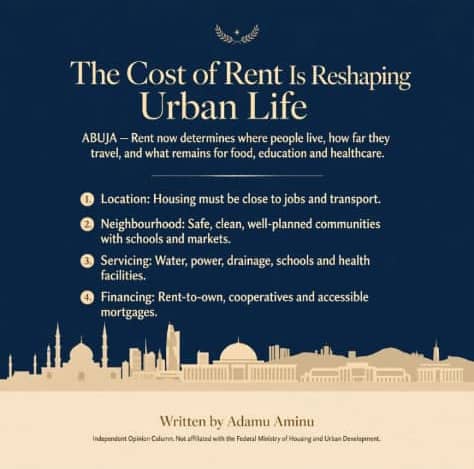
For many urban residents, rent is no longer one expense among others. It is the expense that now determines where they live, how far they travel to work, and what remains for food, education and healthcare.
In Abuja and other major cities, officials, estate agents and tenants report that rents have risen steadily in recent years. The increase is attributed to population growth, limited supply of affordable housing, rising building costs, and the concentration of jobs and services in city centres.
Analysts note that the trend is not limited to high-end districts. It is also evident in satellite towns and peripheral settlements that were once regarded as affordable alternatives.
The effect on households, according to housing experts, is direct and measurable. When rent consumes a large share of income, families adjust.
Some move farther from the city centre in search of lower rents, accepting longer commutes and higher transport costs. Others share accommodation with relatives or colleagues, a practice that increases overcrowding.
In some cases, workers accept housing without adequate water, drainage or reliable power, because it is the only option within their means.
Landlords and property managers, for their part, point to the rising cost of construction, maintenance and land acquisition. They argue that rents reflect the cost of providing and maintaining property in an inflationary environment. Tenant associations, however, contend that increases have in several cases outpaced income growth, placing sustained pressure on low and middle-income earners.
The Federal Ministry of Housing and Urban Development has identified affordability as a central policy concern. Through the Renewed Hope Housing Programme and partnerships with private developers, the ministry states that its objective is to expand the supply of decent and affordable housing for Nigerians across income levels.
The policy position is that increased supply, particularly of serviced and moderately priced units, may ease pressure on the rental market over time.
Experts caution, however, that supply alone may not produce immediate relief. They note that new estates are often located far from employment centres, or priced beyond the reach of the workers they are intended to serve. For rental policy to be effective, they argue, three conditions are necessary.
The first is location: housing must be close to jobs and public transport. The second is servicing: units must have water, power, drainage, and access to schools and health facilities. The third is financing: rent-to-own schemes, cooperative housing and mortgage options must be accessible to earners outside the formal banking system.
The broader implication, planners say, extends beyond housing. When workers spend hours commuting because they cannot afford to live near their workplaces, productivity declines. When families are displaced frequently by rent increases, children’s schooling is disrupted. When young professionals cannot secure stable accommodation, urban life becomes less predictable and less secure.
Rent, in this sense, is not only a housing issue. It is an urban development issue, and a policy issue.
If cities are to remain liveable, analysts argue, housing policy must address not only the number of units built, but also their cost, location and quality. A city in which residents can afford to live near their work, planners add, is more likely to be stable, productive and inclusive.
The editorial judgement is therefore clear. The choices made now on affordability, location and financing will shape the character of Nigerian cities for years to come.
Adamu Aminu writes from Kano
Disclaimer: This is an opinion column. The views expressed are personal and do not represent the Federal Ministry of Housing and Urban Development.
END

