
Odimmegwa Johnpeter/Abuja
The growing shift from reactive disaster response to proactive risk reduction under the leadership of the Director General of the National Emergency Management Agency (NEMA), Mrs Zubaida Umar, is steadily redefining Nigeria’s approach to flood disaster management and climate risk preparedness.
For years, flooding has remained one of Nigeria’s most destructive natural disasters, displacing communities, destroying farmlands and infrastructure, disrupting livelihoods and causing loss of lives across several states. However, recent interventions introduced by NEMA have begun to reshape the national emergency management landscape through stronger early warning systems, community engagement and preventive action.
Under Mrs Umar’s leadership, the agency has intensified efforts to ensure that flood early warning messages are no longer confined to technical reports within government institutions but are simplified, localised and delivered directly to vulnerable communities.
The strategy, which prioritises grassroots engagement, has significantly improved preparedness and contributed to the reduction of flood-related devastation in many high-risk communities across the country.
Through partnerships with state governments, traditional institutions, Local Emergency Management Committees (LEMCs), women groups, youth associations, community volunteers and the media, NEMA has strengthened public awareness and ensured that flood risk information reaches citizens in accessible and understandable formats.
The people-centred disaster management approach reflects the agency’s belief that early warning information can only save lives when it reaches those most at risk promptly and effectively.
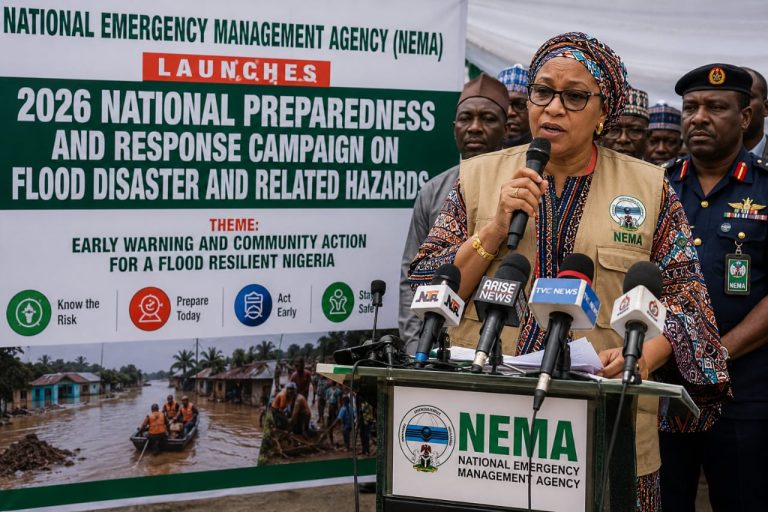
The agency recently reinforced this commitment during the flag-off of the 2026 National Preparedness and Response Campaign on Flood Disaster and Related Hazards in Adamawa State.
Speaking during a courtesy visit to the Governor of Adamawa State, Governor Ahmadu Umaru Fintiri, Mrs Zubaida Umar stressed the need for coordinated collaboration among stakeholders to reduce the impact of predicted flooding across Nigeria.
She disclosed that NEMA had already developed the 2026 Climate-Related Risk Management, Preparedness and Mitigation Framework, alongside flood vulnerability maps identifying communities at risk across the federation.
According to the agency, the measures are designed to strengthen preparedness, protect infrastructure and reduce economic losses associated with flooding and other climate-related hazards.
Beyond policy formulation, NEMA has also commenced nationwide sensitisation campaigns and the downscaling of flood early warning messages to states and communities identified as highly vulnerable to flooding.
The preparedness campaign has already been launched in several states, including Adamawa, Katsina, Anambra, Bayelsa, Jigawa and Delta states, with additional sensitisation activities expected in other flood-prone areas nationwide.
The nationwide campaign focuses on ensuring that climate and flood risk information reaches rural and riverine communities often most exposed to flood disasters.
Communities are being educated on evacuation procedures, safe relocation practices, environmental sanitation, drainage clearance and other preventive measures aimed at minimising disaster impact before flooding occurs.
NEMA has also continued to strengthen community ownership of disaster preparedness through the establishment and empowerment of Local Emergency Management Committees, while encouraging environmental sanitation and the clearing of blocked drainage systems and waterways.
The impact of these interventions is gradually becoming evident as many communities previously affected by annual flood disasters are now better informed, more organised and increasingly responsive to safety advisories and evacuation directives.
State governments have also become more proactive due to sustained engagements and awareness campaigns coordinated by the agency.
The leadership style of Mrs Zubaida Umar has further been described as one driven by professionalism, coordination and strategic foresight at a time when climate change continues to intensify weather-related disasters globally.
Observers note that Nigeria increasingly requires institutions that are data-driven, community-focused and aligned with global best practices in disaster risk reduction and emergency management.
Governor Fintiri’s commendation of NEMA during the Adamawa engagement underscored the growing confidence many state governments now place in the agency’s operational framework and proactive preparedness strategy.
The gradual reduction in flood-related casualties and destruction in several vulnerable communities is being attributed to sustained planning, stakeholder engagement, public sensitisation campaigns and coordinated preparedness efforts by the agency.
As Nigeria continues to confront rising climate-related challenges, stakeholders say the continuity of proactive disaster management policies and grassroots preparedness initiatives will remain critical in reducing the human and economic cost of natural disasters across the country.
END

