
Odimmegwa Johnpeter/Abuja
Nigeria’s security challenges cannot be solved by acquiring sophisticated military platforms alone, retired Air Vice Marshal Sayo Olatunde has said, calling for a broader review of the country’s defence strategy, policing system and foreign military partnerships.
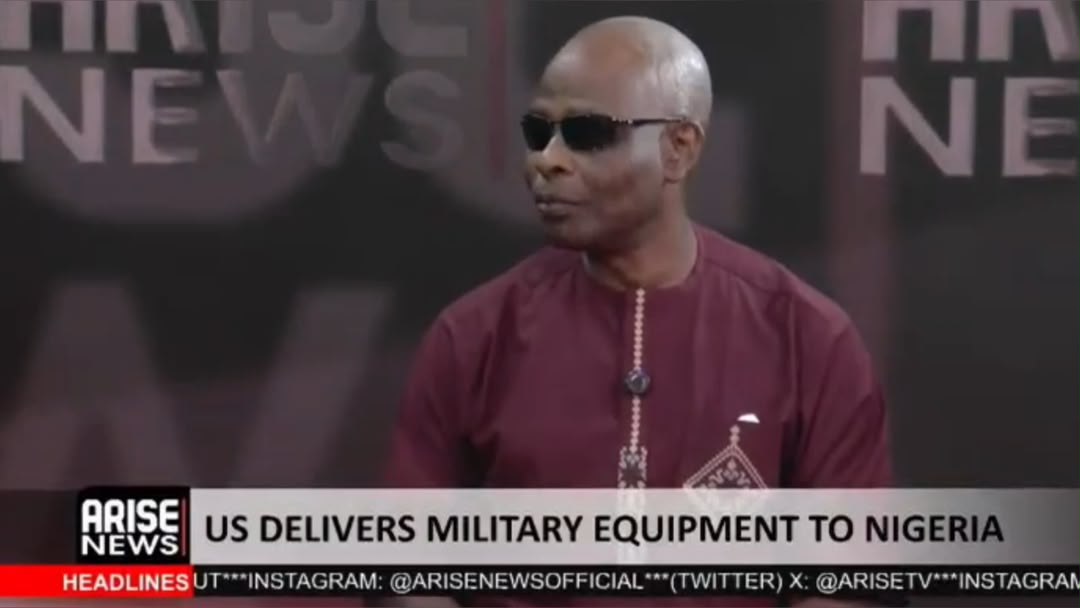
Olatunde, a former Chief of Defence Policy and Plans at Defence Headquarters, former Chief of Policy and Plans, Headquarters Nigerian Air Force and former Commandant of the Nigerian Air Force War College, Makurdi, spoke during an interview on Arise TV’s This Week programme, hosted by Sumner Sambo.
His comments followed reports that a United States Air Force C-17 aircraft had delivered military equipment to the Nigerian Air Force. Olatunde explained that the shipment was not a new assistance package, but part of equipment and weapons previously procured as part of the Super Tucano deal by Nigeria through the United States foreign military sales programme.
He said payments for some equipment linked to Nigeria’s A-29 Super Tucano programme were made as far back as 2018, while the aircraft were delivered in 2 batches in 2021.
According to him, the latest deliveries were largely connected to sustaining the Super Tucano fleet. He cautioned, however, that the presence of advanced aircraft would not automatically translate into victory against terrorism without the supporting systems required to operate them effectively.
“When you buy aircraft, you must also take care of other aspects defence capability” Olatunde said.
He said Nigeria should conduct a comprehensive assessment of its military capabilities to guide future purchases. Such an assessment, he explained, should cover doctrine, organisation, training, materiel, leadership, personnel, facilities and interoperability.
Olatunde said the country’s procurement decisions must be based on lessons from past and current operations, as well as an assessment of future threats. He argued that buying equipment without first identifying capability gaps could lead to waste and limited operational impact.
The retired officer also stressed the importance of developing an indigenous military-industrial complex. He said the Defence Industries Corporation of Nigeria had recorded progress through partnerships with local and international defence companies, including memoranda of understanding and joint venture agreement designed to expand domestic defence production.
He further warned that the military was being overstretched by its continued involvement in internal security operations traditionally assigned to the police.
Rather than focusing only on the debate over state police, Olatunde said attention should be directed towards reforming the existing police system, particularly its effectiveness, professionalism and accountability.
He also called for a reassessment of Nigeria’s relationships with major foreign military powers, saying international assistance must be delivered in a manner that responds to the country’s immediate security needs.
“If you want to help us, that help must be precise and it must be timely,” he said, stressing that Nigeria’s security challenges could not be placed on hold while it waited for military capabilities to arrive.
Olatunde, author of Beyond the Symptoms, said the country’s insecurity was being sustained by deeper structural problems that required long-term solutions.
He identified corruption, porous borders and ungoverned spaces, socio-political polarisation, an ineffective police force and what he described as a defective defence architecture as five major drivers of insecurity.
He urged political leaders and security policymakers to move beyond short-term responses by combining military reform, stronger policing, indigenous defence manufacturing and clearly defined international partnerships.
END

