
Odimmegwa Johnpeter/Abuja
Nigeria has taken another significant step towards accelerating its green industrialisation agenda following the presentation of a landmark Critical Minerals Development Report to the Federal Government during the 5th African Natural Resources and Energy Investment Summit (AFNIS 2026) in Abuja, a statement said on Monday.
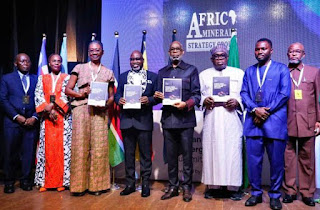
The report was formally handed over by the Council for Critical Minerals Development in the Global South to the Minister of Solid Minerals Development, Dr. Dele Alake, at the State House Conference Centre, Presidential Villa.
Developed through a partnership involving the Council, the Federal Ministry of Solid Minerals Development, and Core International, the report provides a comprehensive roadmap linking Nigeria’s abundant mineral resources to its clean energy ambitions.
It maps the country’s projected demand for solar photovoltaic (PV) systems, energy storage technologies, and electric vehicles while assessing current mineral supply capacity, trade patterns, and existing gaps. It also outlines strategic policy recommendations aimed at strengthening domestic mineral value chains.
According to the report, Nigeria possesses significant deposits of lithium, copper, and bauxite—minerals considered critical for the global energy transition—which align closely with the country’s growing demand for clean energy technologies.
Receiving the report, the Minister of Solid Minerals Development, Dr. Dele Alake described the document as a valuable policy guide for advancing Nigeria’s green industrialisation.
“By mapping domestic demand, supply and trade patterns, this report provides mineral-specific policy pathways to leverage Nigeria’s resources for our own green industrialisation,” Alake said.
The Council for Critical Minerals Development in the Global South announced that the report marks the beginning of a new phase of collaboration with Nigeria. Planned initiatives include developing a mineral-to-manufacturing localisation roadmap to retain greater value within the country, promoting South-South investment partnerships that connect Nigeria with manufacturers and investors across emerging economies, and working with local stakeholders to advance green industrialisation projects.
The presentation also represents the culmination of work initiated during AFNIS 2024, when the Council, the Ministry of Solid Minerals Development, and Core International began collaborating on the report.
The Council for Critical Minerals Development in the Global South is jointly hosted by Sustainable Energy for All (SEforALL) and the Global South Center for Clean Transportation at the Institute of Transportation Studies, University of California, Davis. The initiative supports emerging economies by providing data, policy analysis, and international partnerships to develop secure critical mineral supply chains that promote domestic industrialisation and strengthen regional manufacturing value chains.
The report is expected to support Nigeria’s efforts to maximise the economic benefits of its critical mineral resources while positioning the country as a key player in Africa’s clean energy transition and sustainable industrial development.
END

