
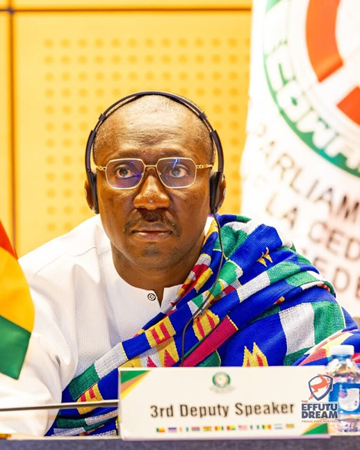
Odimmegwa Johnpeter/Abuja
The ECOWAS Parliament has directed its Committee on Political Affairs to investigate a wave of xenophobic attacks targeting West African nationals in South Africa, amid growing concern over the safety of citizens across the region.
This was consequent to a matter of “direct and profound importance” raised by the Third Deputy Speaker, Alexander Kwamena Afenyo-Markin, during the plenary at the first ordinary session of 2026 held in Abuja on Tuesday.
In a strongly worded intervention, Afenyo-Markin called for urgent accountability and stronger protections after a string of violent incidents, including deadly attacks on West African nationals in Burkina Faso and rising hostility towards African migrants in South Africa. He declared that “a regional community that can not protect its own citizens in transit has not yet earned its name.”
Citing Rule 71, he pressed the chamber to confront what he described as “matters of direct and profound importance”, pointing to killings of ECOWAS citizens, persistent violations of free movement protocols, and repeated attacks on Africans living in South Africa.
He recounted the February 14, 2026 ambush in northern Burkina Faso, where militants linked to Al-Qaeda intercepted a truck carrying 18 Ghanaian tomato traders. According to him, the attackers separated the men from the women before executing them and setting the vehicle ablaze with the driver still inside.
“These were not statistics. They were breadwinners, fathers and sons, the quiet engines of the regional supply chain that feeds our markets,” he told lawmakers.
He also warned that a separate offensive on April 25 in Mali, which claimed the life of the country’s Defence Minister, has effectively cut off the Ghana–Mali trade route. Ghana’s Foreign Ministry, he said, can no longer assure the safety of travellers along that corridor.
“A regional community that cannot protect its own citizens in transit has not yet earned its name,” he repeated.
Turning to South Africa, Afenyo-Markin condemned what he described as widespread xenophobic attacks in KwaZulu-Natal, Cape Town and Pretoria, where nationals from Ghana, Nigeria, Zimbabwe and Ethiopia have reportedly been killed, displaced or had their businesses looted.
While acknowledging recent remarks by Cyril Ramaphosa condemning xenophobia during Freedom Day commemorations, he argued that stronger action was needed.
“Words delivered from a ceremonial platform do not arrest a single perpetrator,” he said, urging South African authorities to ensure thorough investigations and prosecutions without exception.
The Deputy Speaker also turned his criticism inward, faulting ECOWAS for failing to fully uphold its own free movement protocol adopted in 1979. He noted that citizens continue to face harassment at borders, while national policies often clash with regional commitments.
“The daily reality of our citizens contradicts the promise at every turn,” he said.
To address the crisis, Afenyo-Markin outlined a set of proposals, including the creation of a special committee focused on the safety of ECOWAS citizens abroad, a renewed push to enforce free movement rights, and a parliamentary action plan on border governance. He also called for formal communications to be sent to South Africa’s parliament and the African Commission on Human and Peoples’ Rights.
“The safety of our people must never be a matter open to devastation,” he declared.
END

