
Odimmegwa Johnpeter/Abuja
A warning by the Economic Community of West African States (ECOWAS) has identified climate change, environmental degradation, and insecurity as factors increasingly fuelling displacement and threatening regional stability.
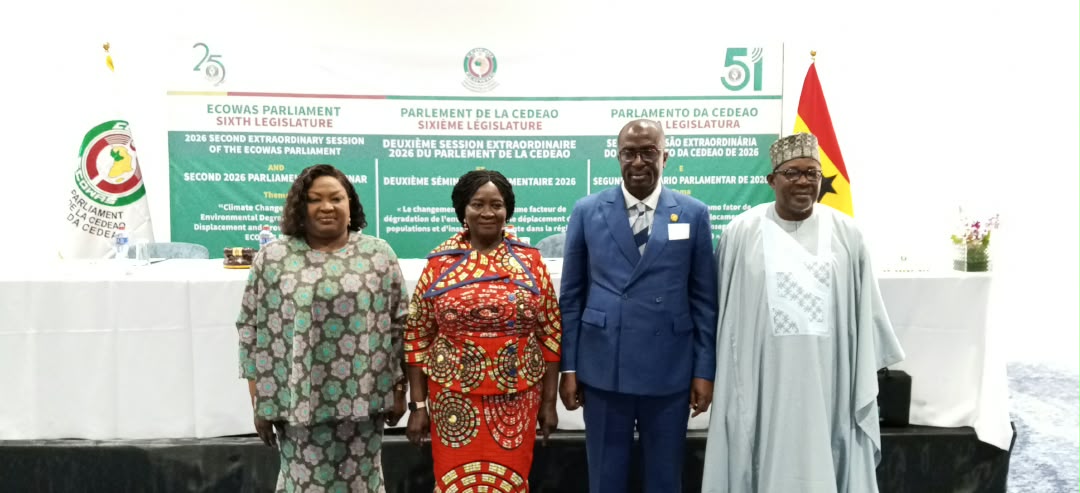
The regional lawmakers handed down this warning at the Second 2026 Parliamentary Seminar of the ECOWAS Parliament in Accra, Ghana, where they were examining the link between climate change, population displacement and rising insecurity.
Professor Nassirou Bako-Arifari, the Commissioner for human Development and Social Affairs who represents the President of the ECOWAS Commission, General Birame Diop, noted that more than two million people were displaced in West Africa in 2024 as a result of natural disasters linked to climate change.
He said more than seven million people were affected by flooding during the same period, with homes, roads, schools, health facilities, farms, and other infrastructure destroyed.
According to the ECOWAS Commission’s presentation between 2025 and 2026, the combined effects of climate change and other sources of insecurity and vulnerability resulted in more than 12 million internally displaced people across West and Central Africa, with women and children accounting for 80% of the figure.
“Climate change is not simply an environmental issue. It is a development issue, a humanitarian issue, a peace and security issue, and ultimately an issue of human survival and regional stability,” Professor Bako-Arifari said.
Bako-Arifari further cited World Bank projections that the number of internally displaced people in the sub-region could reach nearly 32 million by 2050, largely because of the combined effects of climate change.
He recommended a comprehensive regional climate-resilience and human-security agenda by ECOWAS member states instead of their fragmented responses.
His words: “We must be proactive and invest in resilience before crises occur,” adding that the region must protect ecosystems, create livelihoods, and address grievances before they develop into conflict.
The ECOWAS Commission said the region also faces a major climate-financing gap, with an estimated $294 billion needed to address climate financing requirements.
It said ECOWAS had since 2024 been working towards establishing a regional carbon market platform under Article 6 of the Paris Agreement as part of efforts to mobilise investment for climate action.
The Commission urged the parliamentarians to strengthen climate-responsive legislation and oversight, prioritise climate financing, improve early-warning and early-action systems, and promote sustainable management of land, water, forests and fisheries.
Similarly, It also urged governments to place young people and women at the centre of climate resilience, describing them as innovators, entrepreneurs, community leaders, and agents of resilience.
The parliamentary seminar is being held under the theme: “Climate Change as a Driver of Environmental Degradation, Population Displacement and Rising Insecurity in the ECOWAS Region.”
The Second 2026 Extraordinary Session of the ECOWAS Parliament will also consider the institution’s 2027 budget and activity programme.
END

