
Odimmegwa Johnpeter/Abuja
The Federal Government through the Ministry of Environment on Thursday 8, October, 2026 commended the Society for Planet and Prosperity (SPP), for its effort in sustaining the annual subnational climate governance ranking and rating which is in its third edition.
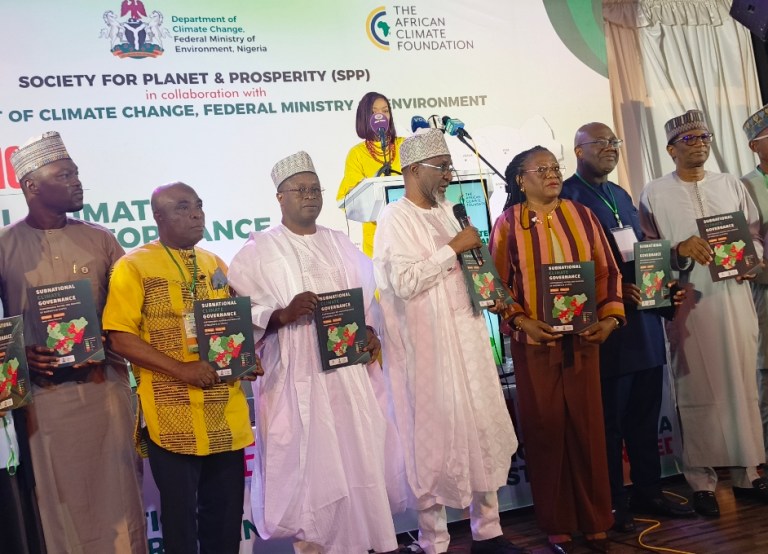
Speaking at the launch of the Subnational Climate governance performance rating and ranking in Abuja, organised by the MD/CEO of SPP, Prof. Chukwumerije Okereke, the Minister superintending the Ministry, Mr. Balarabe Lawal, acknowledged that the initiative constitutes an important evidence-based mechanism to assess the progress that the States are making in climate governance.
He said: “It allows us to ask practical questions: Do States have functional climate governance structures? Are climate priorities reflected in plans and budgets, are resources being mobilized. Are projects being implemented? And, most importantly, are these actions delivering measurable benefits for our people?”
He acknowledged that the nationwide project is not just about unveiling the ranking or report, but to take stock of the country’s progress, recognise achievements, identify areas requiring greater effort, and renew our collective commitment to translating Nigeria’s climate ambitions into practical results across our States and communities.
The Minister added: “The purpose of this initiative is fundamentally about strengthening climate change governance delivery, because Climate change is no longer a distant environmental concern, it is a development, economic, social and security imperative.
“Its impacts are increasingly felt through flooding, excessive heat, drought, pressures on agriculture and food systems, water resources, infrastructure, livelihoods and human settlements.
“Nigeria’s climate response cannot be delivered by the Federal Government alone.
According to Lawal, the success of the federal government’s national commitments will ultimately depend on the strength of implementation at the subnational and community levels.
Commending the convener of the project, Prof. Chukwumerije Okereke, he said with the introduction of this initiative, stakeholders have seen encouraging progress, including stronger climate institutions, improved policy and planning frameworks, better coordination, and growing implementation of climate-resilient and low-carbon initiatives.
Lawal said: “This Third Edition takes us another step forward— from institutions and policies to implementation, investment and results.
“Our priorities are clear: stronger State climate institutions; greater integration of climate priorities into plans and budgets; increased mobilisation of climate finance; stronger pipelines of bankable projects; improved implementation of adaptation and mitigation actions; and tangible benefits for our communities.
“The leadership of State Governments is indispensable. I therefore call on our Governors to make climate action an integral part of their development and delivery, integrate climate considerations into State plans and budgets, and create an enabling environment for climate finance, private investment and strategic partnerships.
“I encourage every State to establish a clear pathway from policy to budget, budget to projects and projects to measurable results.
“The ranking should not be viewed merely as a scorecard, but as a strategic management and accountability tool for identifying gaps, tracking progress and accelerating delivery to our high-performing States.
“I commend your progress and encourage you to go further, deepen implementation and share your knowledge and successful approaches. To States still strengthening their systems, this is an opportunity to consolidate progress and accelerate action.
“And to those at an early stage, I urge you not to be discouraged. This exercise is not about stigmatising States; it is about illuminating the pathway for improvement.”
He said President Bola Tinubu, remains committed to partnering with relevant stakeholders to provide the technical assistance, capacity development and collaboration needed to support this journey.
“Our Commissioners of Environment and other State institutions are encouraged to translate climate leadership into action through stronger coordination, credible project pipelines, and effective monitoring and reporting. Development partners, financial institutions, the private sector, academia and civil society must also help us move from policy to investment, innovation and scale.
“At the heart of these efforts are our communities. Climate action must respond to local realities and deliver tangible benefits to our people. Women, youth, farmers, businesses and vulnerable groups must therefore be meaningfully engaged as partners and agents of climate resilience.
“As Nigeria advances the implementation of NDC the National Adaptation Plan and other national climate priorities, effective State-level delivery is indispensable.
“The message is simple: stronger institutions, better planning, greater investment, faster implementation and measurable results.
“Let us use this Third Edition to transform competition into constructive learning, rankings into accountability, and commitments into tangible outcomes.
“I commend all 36 States and FCT for their participation and continued commitment, and encourage every State to use this initiative as a pathway towards stronger climate governance, greater resilience and sustainable development.
“With the leadership of our Governors, the commitment of our Commissioners, the support of our partners and the active participation of our communities, we can build a more resilient, low-carbon and prosperous Nigeria-leaving no State and no community behind.
Fielding questions from journalist at the sideline of the event, Okereke, said the event was very significant because SPP launched the third edition of the Subnational Climate Governance, Performance, Ranking, and Rating, which covers all the 36 states.
He said: “One of the reasons why I am very, very excited about today is that the ranking and rating report, which we launched today, shows that all the states are making significant progress in the governance and action on climate change.
“We started this work in 2023 when we did a mapping of the state of climate policy and impact and public awareness of climate change in all the 36 states.
“We saw that in all parameters, states are doing very, very poorly, even though there were some exceptions. We thought, how do we encourage states to do more in the absence of strong regulation?
“And we came up with this innovative idea that one way we can do that is to compile what states are doing, to rate them and rank them, and use that as a way to stimulate competition so that states can begin to compete to do better. And what we have seen is that this idea is working.
“In the first year when we did it, 2024, for example, there was no state that had done Green Bond or significant climate investment instrument.
“By the second year when we did it, two states had done Green Bond and other significant climate investment instrument. And now this year, we have four states that have triggered significant quantum of climate investment.”
Prof. Okereke, acknowledged that there are growth in the number of states that are doing climate policies and action plan, adding that in the first year when the project started it is only about eight (8) states had climate policies and action plans.
He said: “Now we have 16 states that have climate policies and action plans. In the first year that we did this, very few states had senior advisors or special assistants on climate change.
“Now we have about 21 states that have appointed special assistants and senior advisors to climate change.
“The first year we did this ranking, only two states had honorable commissioners for environmental designation.
“Today, we have about 12 or 13 states that are called honorable commissioners for environment and climate change, putting climate change in the title of their commissioners.
“I can go on and on and on about how this ranking is stimulating better performance on the environment in all states.
“So that’s the significance of this event. And then I was saying, so what about the announcement for oil and gas? Well, having seen the way in which our ranking and report is stimulating and instigating and facilitating better environmental governance and performance at the states, we want to take the same approach to the oil companies.
On SPP’s next move to interrogate oil companies on their climate governance compliance, he acknowledged that oil and gas companies account for a significant amount of greenhouse gas emission in Nigeria and globally, but nobody knows what they are doing.
Okereke said: “Our ranking will now move from the states and to encompass oil and gas. And after that, we’ll add industry, manufacturing, then we’ll add telecommunication, and we’ll also add banking.
“We are going to expand the list because that is what the law says, that all companies, as long as you’re employing above 50 people, you’re supposed to keep a record of your action on climate change.”
He however regretted that because Nigeria has not been implementing climate governance law, most companies haven’t been doing that. So this ranking and rating is an opportunity for us to bring some level of accountability to what oil and gas companies are doing.
END

