
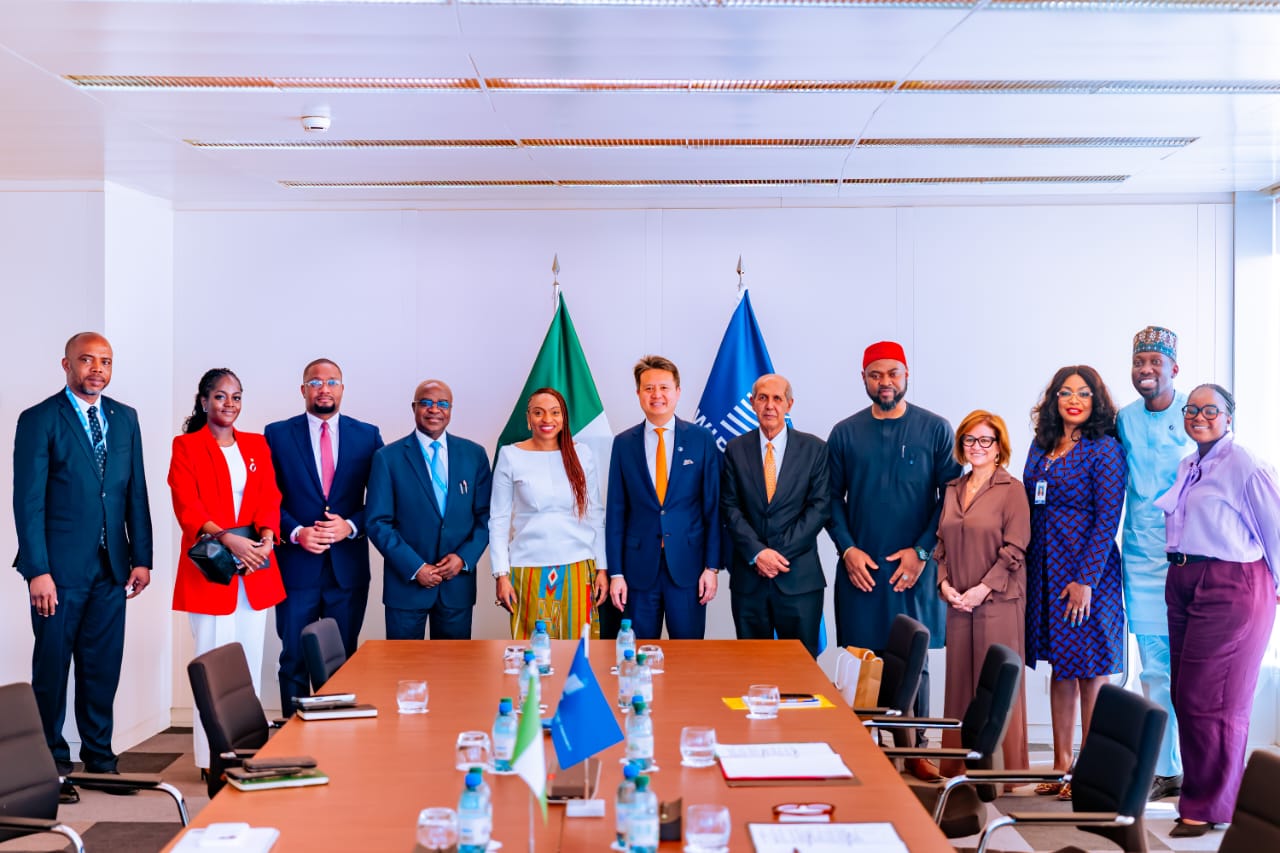
Odimmegwa Johnpeter/Abuja
Nigeria has reaffirmed its commitment to building an inclusive and development-oriented global intellectual property (IP) system, declaring that the protection and commercialization of intellectual property are critical to unlocking the country’s vast creative and innovation potential and accelerating economic growth. This was contained in a statement signed by Obilor-Duru Augustina Okechi, Head, Press, and Public Relations, FMITI.
Speaking during the Opening Session of the Sixty-Eighth (68th) Series of Meetings of the Assemblies of the Member States of the World Intellectual Property Organization (WIPO) in Geneva, Switzerland on July 7, 2026.
The Honourable Minister of Industry, Trade and Investment, Dr. Jumoke Oduwole, who led Nigeria’s delegation, stressed that intellectual property must serve as “a living instrument of inclusion” that empowers creators, innovators, and businesses.
The Minister congratulated WIPO Director General Daren Tang on his re-election and reaffirmed Nigeria’s support for the statement delivered by South Africa on behalf of the African Group.
Dr. Oduwole noted that although Nigerians have earned global recognition for their creativity and innovation across music, Nollywood, sports, fashion, food, science, literature and technology, the country is yet to fully capture the economic value generated from these sectors.
”From Afrobeats to Nollywood, fashion, food, science, literature and technology, Nigerians are globally recognised for their creativity and innovation. However, not enough of the value generated is flowing into our economy. This is about to change,” she declared.
The Minister highlighted the Federal Government’s ongoing reforms aimed at transforming Nigeria’s intellectual property ecosystem, including the implementation of the National Intellectual Property Policy and Strategy launched in 2025.
She explained that the policy is being driven through an Inter-Ministerial Steering Committee, which she co-chairs with the Honourable Attorney General and Minister of Justice, alongside an Inter-Agency Coordination Group responsible for technical implementation.
She expressed appreciation to WIPO for its technical support in developing the policy and welcomed the recent visit of Director General Daren Tang to Abuja, describing it as a significant milestone in strengthening Nigeria WIPO cooperation.
Dr. Oduwole further disclosed that Nigeria’s delegation to this year’s WIPO Assemblies is the country’s largest ever, bringing together key stakeholders from both the public and private sectors to demonstrate the nation’s renewed commitment to intellectual property development.
According to her, Nigeria is modernizing its intellectual property registries, advancing the protection of traditional medicine and indigenous knowledge through the Patents Registry, pursuing legislative reforms and strengthening stakeholder collaboration to improve the country’s IP ecosystem.
She also announced a strategic collaboration between the Small and Medium Enterprises Development Agency of Nigeria (SMEDAN) and the WIPO Nigeria Office to expand access to intellectual property services for Micro, Small and Medium Enterprises (MSMEs), recognizing their critical role in national economic development.
The Minister underscored the growing importance of intellectual property to Africa’s economic integration agenda, noting that she recently assumed the position of Chair of African Ministers responsible for Trade under the African Continental Free Trade Area (AfCFTA), while Nigeria also serves as the Digital Trade Co-Champion under the continental agreement.
She called for greater prioritization of intellectual property protection and commercialization across Africa, describing it as essential for industrialization, technology transfer, digital trade, and sustainable economic transformation.
As the WIPO Development Agenda approaches its twentieth anniversary, Dr. Oduwole urged Member States to fully mainstream development considerations across all committees and norm-setting processes of the Organization.
”In a fragmenting world, WIPO’s multilateral centrality is a strategic necessity. Nigeria remains firmly committed to building an inclusive, balanced, and future-ready global intellectual property ecosystem that leaves no region behind,” she concluded.
END

