
Odimmegwa Johnpeter/Abuja
Nigeria is taking a major step towards creating a regulatory environment where innovation can thrive without compromising public safety, legal compliance or institutional oversight, as the National Information Technology Development Agency (NITDA) moves to operationalise a National Regulatory Sandbox.
At the centre of the initiative is a push for government regulators to abandon fragmented approaches and work together in creating a coordinated framework that will allow innovators to safely develop, test and scale emerging technologies.
The Director-General of NITDA, Kashifu Inuwa, CCIE, made this clear at the National Regulatory Sandbox Governance and Implementation Planning Workshop in Abuja, where he called for stronger inter-agency collaboration to move the initiative from design to implementation.
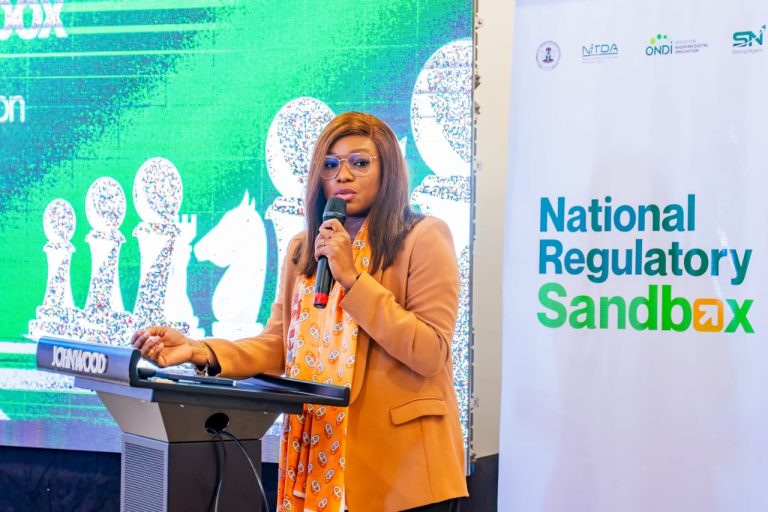
Represented by the National Coordinator of the Office for Nigerian Digital Innovation (ONDI), Ms. Victoria Fabunmi, Inuwa described regulatory cooperation as the cornerstone of a successful National Regulatory Sandbox and stressed that its effectiveness would depend on the collective ownership of relevant regulatory institutions.
According to him, the objective is not to weaken regulation, but to build a smarter and more coordinated system capable of keeping pace with the speed of technological change.
The Director General of the National Information Technology Development Agency (NITDA), Kashifu Inuwa, CCIE, represented by the National Coordinator of the Office for Nigerian Digital Innovation (ONDI), Mrs. Victoria Fabunmi, delivering his remarks at the National Regulatory Sandbox Governance and Implementation Planning Workshop held in Abuja.
He said the workshop marked a critical transition from the design phase of the initiative to implementation, providing regulators and stakeholders an opportunity to jointly interrogate, refine and validate the proposed governance structure before its rollout.
“The work completed so far provides a solid foundation, but the National Regulatory Sandbox can only achieve its objectives through collective ownership by all relevant regulatory institutions,” Inuwa said.
The NITDA boss disclosed that ONDI had spent several months laying the groundwork for the initiative through extensive stakeholder consultations, ecosystem mapping, regulatory assessments and the preparation of a draft governance and implementation framework.
He explained that the Technical Working Group was deliberately constituted as a collaborative platform to bring together the expertise, experience and statutory responsibilities of participating agencies in developing a regulatory model that reflects Nigeria’s unique innovation landscape.
For Inuwa, the different mandates of government regulators should not constitute barriers to innovation. Rather, he said, they should be harnessed as complementary strengths in developing a flexible regulatory framework capable of responding to emerging technologies.
The workshop, he added, would help establish clear implementation pathways, strengthen institutional partnerships and identify priority actions required to operationalise the Sandbox.
Beyond regulatory coordination, the initiative is expected to create a controlled environment where innovators can experiment with new technologies and business models while engaging regulators early enough to address compliance requirements and potential risks.
This, stakeholders believe, could significantly reduce regulatory uncertainty for Nigeria’s rapidly expanding technology ecosystem.
Speaking on the journey and current workstream of the National Regulatory Sandbox, Ms. Ojonoka Yusufu, Implementing Partner, Druve, said the initiative was designed to bring regulators and innovators into a structured environment where emerging technologies could be tested responsibly.
She stressed that the framework was still evolving, with the workshop providing an opportunity for participating institutions to collectively shape its final architecture.
“We do not have anything set in stone yet. The idea is to work together to build a common understanding and ensure that all participating regulators and stakeholders are aligned on the objectives and implementation of the National Regulatory Sandbox,” Yusufu said.
She explained that the workshop was aimed at developing consensus around the Sandbox’s operating model, identifying gaps that could hinder implementation and agreeing on practical steps required before rollout.
The urgency of the initiative, she noted, is underscored by the rapid transformation of Nigeria’s startup ecosystem.
Nigeria’s technology sector has expanded beyond the traditional fintech space, with startups increasingly operating in healthcare, mobility, agriculture and other sectors where innovation intersects directly with existing regulatory frameworks.
Yusufu said Nigerian startups were not only creating employment opportunities but also attracting foreign investment and strengthening the country’s reputation as one of Africa’s leading innovation destinations.
As these technologies become more complex and cross-sectoral, she said, closer coordination among regulators has become imperative.
The National Regulatory Sandbox is backed by the Nigeria Startup Act, providing a legal foundation for promoting responsible innovation and improving the country’s regulatory environment.
Importantly, the Sandbox is not designed to replace existing regulatory agencies or diminish their statutory powers.
Rather, it is conceived as a collaborative, multi-agency innovation governance mechanism that will enable regulators to work together while retaining their respective mandates.
For Nigeria, the significance of the initiative extends beyond technology.
A regulatory environment that can accommodate innovation without sacrificing accountability could help attract investment, support indigenous technology companies, accelerate digital transformation and strengthen the competitiveness of the Nigerian economy.
It also offers regulators an opportunity to understand emerging technologies before they become widespread, allowing policy and regulatory responses to be informed by evidence rather than speculation.
The success of the National Regulatory Sandbox, however, will ultimately depend on the willingness of regulatory institutions to collaborate, share information and embrace a common approach to emerging technologies.
With the initiative now moving from framework design towards implementation, NITDA is betting on coordinated regulation as a pathway to responsible innovation—and potentially, a more competitive Nigerian digital economy.
END

