
Odimmegwa Johnpeter/Abuja
The Russian Federation has rejected what it described as a distorted narrative of W11 and justified its intervention in the Ukrainian war. It strongly defended its military intervention in Ukraine, arguing that the conflict’s origins date back to 2014 and not February 2022, as widely portrayed by Western countries.
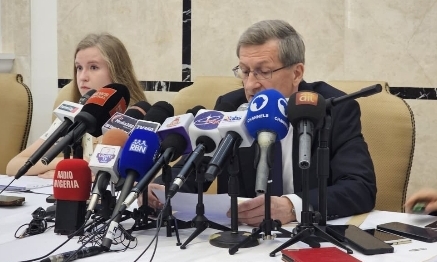
Russian Ambassador to Nigeria, Andrey Podelyshev stated this during a press briefing in Abuja.
Furthermore, he dismissed claims that Russia launched an unprovoked invasion, instead framing the war as a response to years of political instability, alleged human rights violations, and growing security threats near its borders.Politics
Podelyshev insisted that the crisis began during the 2013–2014 protests in Kyiv, which culminated in what he described as a Western-supported “coup d’état.
He said the upheaval forced the then Ukrainian President, Viktor Yanukovych, to flee the country, creating a power vacuum and triggering deep divisions within Ukrainian society.
Similarly, he alleged that the new leadership in Kyiv adopted policies that marginalized Russian-speaking populations, including restrictions on the use of the Russian language across education, media, and public life.
According to him, these fueled resistance in regions such as Crimea and the Donbass.
He further argued that tensions escalated into armed conflict when Ukrainian forces engaged separatist groups in eastern Ukraine, resulting in years of violence and civilian casualties that received little international attention.
Russia maintained that the failure of the Minsk Agreements, a set of internationally backed accords designed to end hostilities and reintegrate the breakaway regions into Ukraine with special status was vital to the crisis.
According to the ambassador, Ukraine, supported by Western allies, did not fulfil its obligations under the agreements.
His words: “Russia consistently pushed for a peaceful resolution through the Minsk framework”. He also added that Moscow only resorted to military action after diplomatic avenues were exhausted.
The envoy also defended Russia’s recognition of the self-proclaimed republics in Donetsk and Luhansk, stating that their appeals for assistance compelled Moscow to act under mutual defense arrangements.
In addition, the envoy criticized Western governments for what he described as selective interpretation of international law, particularly their emphasis on territorial integrity while, in his view, ignoring the principle of self-determination.
Podelyshev explained that Russia’s objective was not territorial expansion but the protection of civilians and the prevention of further violence, maintaining that the country’s actions should be understood within a broader historical and geopolitical context.
END

