
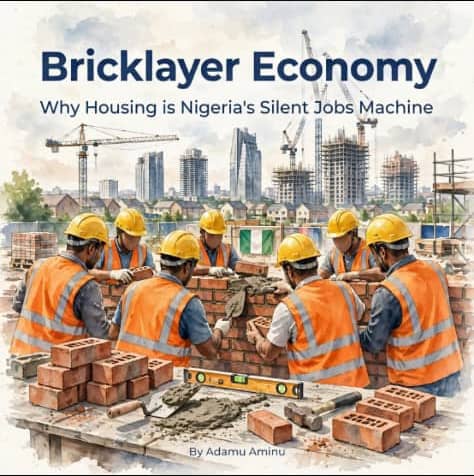
By Adamu Aminu.
As of January 2026, Nigeria’s housing deficit stands at 14.925 million units for 2025, according to the National Housing Data Technical Committee established by the Federal Ministry of Housing and Urban Development. The Ministry separately estimated that approximately 15.2 million existing homes were inadequate.
These figures describe different dimensions of the housing problem and should not be added together.
The significance of this deficit goes beyond shelter. When a house goes up, the story does not end with the family that moves in. It begins with the mason laying blocks, the carpenter framing the roof, the welder fabricating gates and the trader supplying cement. Few sectors connect investment to so many livelihoods.
Construction generates demand for labour, building materials, transportation and retail services. The Ministry has estimated that each housing unit creates an average of 25 direct and indirect jobs, reporting more than 252,800 jobs associated with ongoing projects. These are government-reported estimates, not independently audited employment figures. Their credibility would benefit from published details showing how the jobs were calculated and sustained.
Nigeria’s labour-market statistics also require careful interpretation. The National Bureau of Statistics reported youth unemployment of 6.5 per cent among people aged 15-24 in the second quarter of 2024. The frequently cited 53.4 per cent figure dates from the fourth quarter of 2020 and uses an earlier methodology. The two figures are not directly comparable.
The Ministry’s contribution to housing-led employment extends beyond construction. Its responsibilities include housing data, project delivery, partnerships with private developers and support for skilled artisans.
According to the Ministry, the Renewed Hope Cities and Estates Programme began in February 2024 with a 3,112-unit project in Karsana, Abuja, and includes a planned 2,000-unit Renewed Hope City in Kano.
These figures describe planned project capacity, not necessarily completed or occupied homes.
In September 2025, the Ministry and Polaris Capital Limited signed an agreement to launch the National Artisan Skills Acquisition Programme, targeting training, certification and job connections for 100,000 artisans. The outcome will depend on implementation and evidence that trained workers secure paid employment.
Financing remains a major constraint. Daily Trust reported in January 2026 that the Ministry’s ₦105 billion budget allocation represented about 2 per cent of an estimated ₦5 trillion annual housing-sector requirement. Meanwhile, according to the Ministry of Finance Incorporated, its Real Estate Investment Fund offers eligible borrowers mortgage financing at 9.75 per cent annually. Its wider impact will depend on affordability and access.
Housing policy is also employment and industrial policy. To sustain the employment benefits, there is need for published job-creation methodology, timely release of housing data and expanded access to affordable mortgages.
The real test is whether homes are completed, financing reaches buyers and workers secure meaningful livelihoods.
The bricklayer is not a minor figure in the national economy. He is one of the people through whom housing investment becomes a livelihood.
Adamu Aminu writes from Kano.
Disclaimer: This article is a personal analysis by Adamu Aminu. Views expressed are personal and do not represent the official position of the Federal Ministry of Housing and Urban Development.

