
Odimmegwa Johnpeter/Abuja
The Federal Government has reiterated its commitment to ensuring equitable access to quality sickle cell care for all Nigerians, irrespective of their geographical location, income level, or social status. This was contained in a statement signed by Ado Bako, Assistant Director, Information and Public Relations.
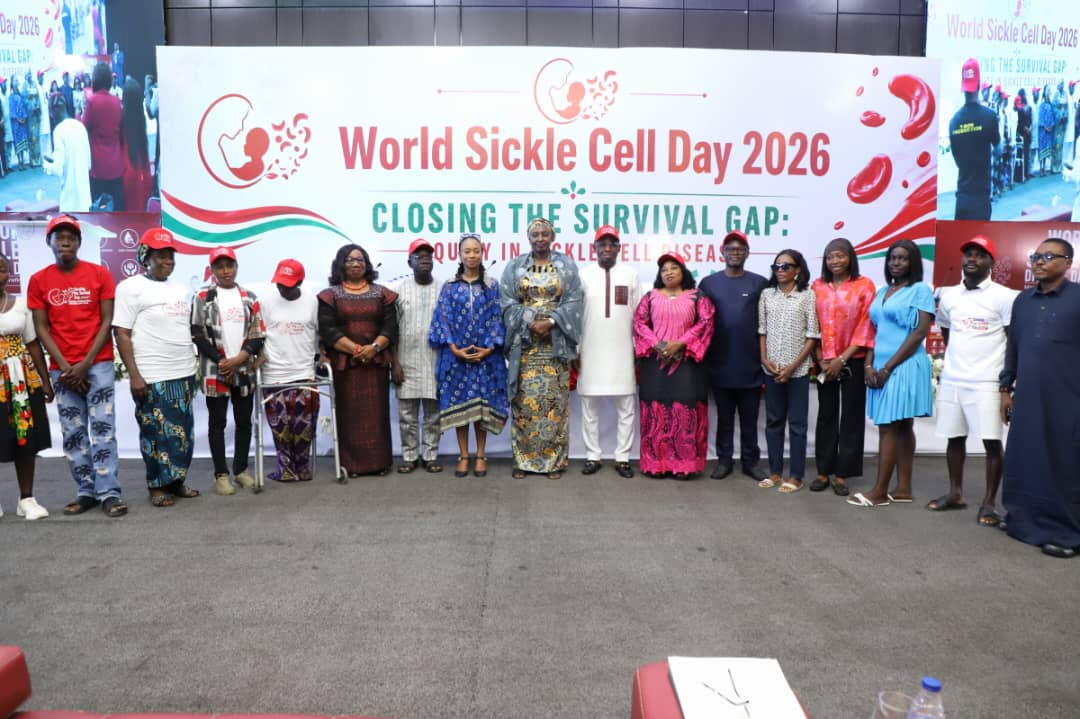
The Coordinating Minister of Health and Social Welfare, Professor Muhammad Ali Pate, CON, made this known in his Keynote address during the 2026 World Sickle Cell Day Press Briefing held in Abuja.
Speaking on the theme, “Closing the Survival Gap: Equity in Sickle Cell Care,” the Minister, who was represented by the Permanent Secretary of the Ministry, Daju Kachollom S. mni described the burden of sickle cell disease (SCD) in Nigeria as a major public health challenge requiring urgent and sustained action from government, development partners, healthcare providers, communities, and citizens.
According to him, Nigeria remains the country with the highest burden of sickle cell disease globally, with about 25 percent of adults carrying the sickle cell gene and an estimated 100,000 infants dying annually from complications associated with the disease, expressing concern that despite advances in medical science, many Nigerians living with the disease continue to face significant barriers to diagnosis, treatment and quality healthcare services, resulting in avoidable deaths and reduced quality of life.
He emphasized that the Federal Government, under the Renewed Hope Agenda of President Bola Ahmed Tinubu, GCFR, is committed to building an equitable, resilient and responsive health system through the Nigeria Health Sector Renewal Investment Initiative (NHSRII), which prioritizes improved access to healthcare, financial protection and better health outcomes for all Nigerians.
The Minister highlighted several ongoing interventions aimed at reducing the burden of sickle cell disease and improving survival outcomes across the country, among which include the implementation of the Universal Newborn Screening Policy for Sickle Cell Disease in selected primary and secondary healthcare facilities in Lagos state, Kano State and the Federal Capital Territory with support from the Clinton Health Access Initiative (CHAI).
Pate highlighted that the Ministry has reviewed the National Guidelines for the Prevention, Control and Management of Sickle Cell Disease to strengthen the use of evidence-based interventions, including Hydroxyurea therapy, and has commenced training of primary healthcare workers beginning with the South-West geopolitical zone, while plans are underway to extend the programme nationwide to support implementation.
He further announced the establishment and equipping of six Centres of Excellence for Sickle Cell Disease, one in each geopolitical zone, fitted with High-Performance Liquid Chromatography (HPLC) machines and other critical resources to enhance newborn screening, diagnosis and comprehensive care, adding that
Government has also validated and adopted Sicklescan, an innovative point-of-care screening technology that provides faster, more accessible and cost-effective testing for sickle cell disease.
Detailing further on government interventions, the Minister stated that sickle cell services are being integrated into Primary Healthcare platforms and the Nigeria Package of Essential Non-Communicable Disease Interventions (Nigeria-PEN) to improve access to counselling, screening, referral and treatment services at community level.
He added that the Ministry is engaging the National Health Insurance Authority (NHIA) to incorporate affordable newborn screening, essential diagnostics and subsidised Hydroxyurea therapy into the national health insurance benefit package as part of efforts to advance Universal Health Coverage.
Professor Pate reaffirmed Nigeria’s leadership role in global efforts to combat sickle cell disease, recalling that the country hosted the 5th Global Sickle Cell Congress in Abuja in 2025 and continues to contribute actively to the Africa CDC Regional Strategy on Sickle Cell Disease and other inherited blood disorders.
He called on Nigerians to know their genotype, seek genetic counselling where necessary, support persons living with sickle cell disease, and help eliminate stigma and discrimination associated with the condition.
“The Federal Government remains firmly committed to strengthening prevention, expanding access to quality care and improving outcomes for people living with sickle cell disease. Together, we can build a future where every person living with sickle cell disease is treated with dignity, supported with compassion, and given the opportunity to live a healthy and productive life,” the Minister assured.
In his welcome remarks, the Director, Public Health, Dr. Charles Nzelu said sickle cell disease is one of the country’s public health threads, pointing out that only fifty per cent of children born with the disease survive beyond the age of five.
He re-emphasized that the best way to control the disease is prevention, therefore urged Nigerians to know their genotype and seek for genetic counselling before marriage.
The Director further called on development partners, civil society groups, traditional and religious institutions, and the media to support the government through creating awareness to help in control the disease.
In her goodwill message, Professor, Obiageli Nnodu, Director, Centre of Excellence for Sickle Cell Disease Research and Training, University of Abuja, and Special Adviser to the Honourable Minister of Health, on sickle cell, said researchers have screened more than 38,000 babies in the FCT and established a disease registry containing over 10,000 patients from 25 centres nationwide.
She stated that the centre is collaborating with government and other stakeholders to strengthen newborn screening, improve patient care and position Nigeria as a leader in sickle cell disease research and treatment, revealing that more than 700 genetic counsellors have been trained across the country, while efforts are on top to increase the use of Hydroxyurea therapy among patients.
Other organizations that presented their goodwill messages include: Bond Chemical Industry, Codix Pharmaceutical among others with assuring of their continued unflinching support in closing the survival gap of persons with lived experience (person with sickle cell disease).
Dr. Alayo Sopekan, National Coordinator, Non-communicable Diseases, in his vote of thanks, acknowledged the contributions of development and implementing partners such as WHO, CHAI, professional bodies, supporting groups and institutions for their tremendous support, and cooporation.
END

