
Odimmegwa Johnpeter/Abuja
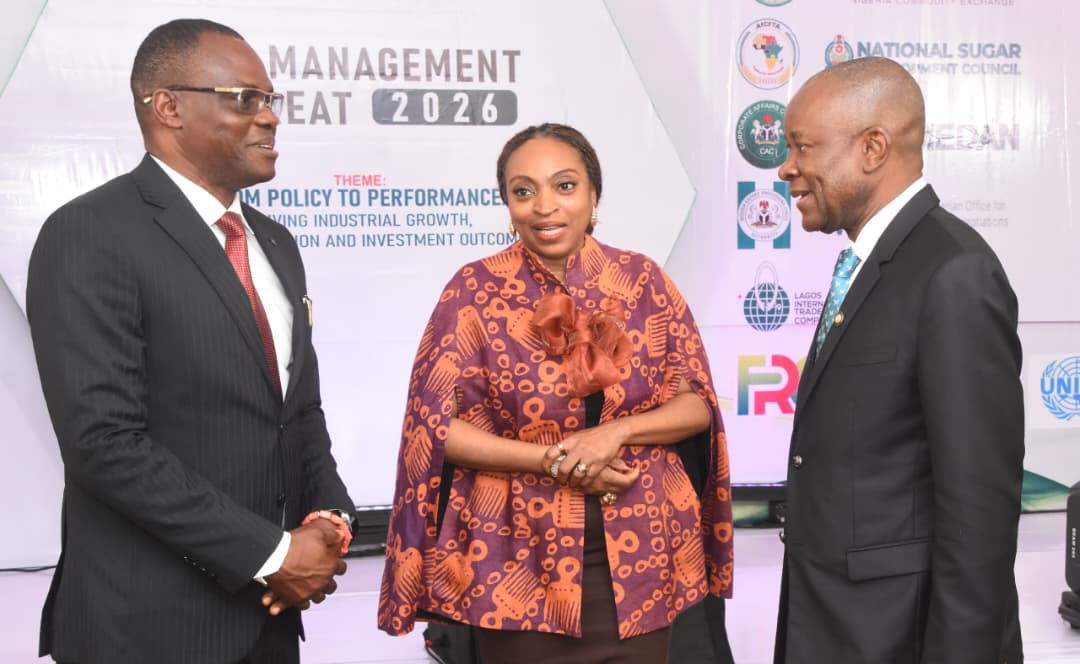
The Federal Ministry of Industry, Trade and Investment (FMITI) has reaffirmed its commitment to accelerating Nigeria’s industrialization, expanding trade, and attracting strategic investments as it convened its 2026 Top Management Retreat in Abuja with the theme: “From Policy to Performance: Driving Industrial Growth, Trade Expansion and Investment Outcomes.” This was contained in a statement signed by Obilor-Duru Augustina Okechi, Head, Press, and Public Relations.
Addressing participants at the two-day retreat held from June 22–23, 2026, the Honourable Minister, Federal Ministry of Industry, Trade and Investment, Dr. Jumoke Oduwole highlighted the Ministry’s significant achievements over the past year and emphasized the need to translate policy initiatives into measurable economic outcomes.
The Minister noted that Nigeria recorded notable progress in 2025, including approximately $21 billion in capital importation, over $6.1 billion in non-oil exports, expanded intra-African trade, and support for more than 115,000 Micro, Small and Medium Enterprises (MSMEs) through grants, loans, and trade finance interventions.
She also disclosed that the Ministry successfully completed Africa’s first comprehensive five-year review of the African Continental Free Trade Area (AfCFTA) implementation and continued to advance export connectivity, investment facilitation, intellectual property reforms, and support for exporters and manufacturers.
Looking ahead, Dr. Oduwole outlined a four-pronged strategy for 2026 focused on expanding demand for Nigerian products and services, strengthening domestic industrial capacity, attracting strategic investments, and leveraging data, artificial intelligence, and digital infrastructure to improve service delivery.
She stressed the importance of stronger coordination across the Ministry and its agencies to provide more efficient support to businesses, investors, and exporters.
The Minister further highlighted achievements recorded since 2024, including an 11 percent increase in non-oil exports, over $6 billion in investment inflows, more than $50 billion in investment announcements, progress on key trade agreements, and encouraging early results from the newly approved Nigeria Industrial Policy.
According to her, these efforts are critical to driving industrialization, economic diversification, job creation, and Nigeria’s long-term ambition of building a $1 trillion economy.
In his remarks, the Honourable Minister of State for Industry, Senator John Owan Enoh, described the retreat as a strategic platform for reflection, alignment, and renewed commitment to delivering tangible economic results.
He noted that the Ministry has made substantial progress over the past two years, particularly through the implementation of the Nigeria Industrial Policy.
To strengthen accountability, Senator Owan Enoh revealed that the Ministry has adopted a 90-day implementation reporting cycle, with the first progress report already completed.
He emphasized that policy success depends not only on formulation but also on effective implementation supported by investment, technology, skills development, infrastructure, financing, innovation, standards, and strong collaboration among stakeholders.
senator Owan highlighted ongoing industrial development programmes, skills initiatives, quality assurance interventions, and efforts to position Nigeria for future industries such as electric mobility and advanced manufacturing.
He noted that the Industrial Policy Implementation Matrix prioritizes industrial growth, MSME development, employment and skills, financing and investment, export competitiveness, sustainability, regional trade integration, energy, infrastructure, and security. He added that progress would ultimately be measured by increased production, job creation, higher exports, reduced imports, and stronger investor confidence.
Earlier, the Permanent Secretary of FMITI, Dr. Chris Osa Isokpunwu underscored the significance of the retreat’s theme, stressing that citizens judge government performance by outcomes rather than policies.
He noted that the Ministry’s success must be reflected in industrial growth, increased investments, expanded exports, improved trade facilitation, and job creation.
The Permanent Secretary commended the leadership of the Honourable Minister and the Honourable Minister of State for Industry in advancing Nigeria’s industrialization agenda and implementing the Renewed Hope Agenda.
He emphasized the need for Nigeria to strengthen its competitiveness in a rapidly evolving global economy and highlighted key priorities including implementation of the Nigeria Industrial Policy, promotion of domestic manufacturing, MSME development, investment promotion, intellectual property administration, and effective implementation of AfCFTA.
Dr. Isokpunwu explained that the retreat was designed to review performance, align strategies across the Ministry and its agencies, identify implementation challenges, strengthen collaboration, and accelerate the delivery of results.
He called for greater accountability, urging participants to measure success through concrete outcomes such as industries established, investments attracted, exports increased, jobs created, and investor confidence strengthened.
Delivering a goodwill message, the Representative of the United Nations Industrial Development Organization (UNIDO), Dr. Reuben Bamidele, and representative of the Chairman Senate Committee on Industries Mr Oluwafemi Ajibabi, commended the retreat as a timely platform for strengthening policy implementation and economic transformation.
Dr. Bamidele reaffirmed UNIDO’s commitment to supporting Nigeria’s industrialization agenda through the Nigeria Country Partnership Programme, while the representative of the Chairman Senate Committee on industries reiterated their support for legislative and oversight initiatives that promote industrial competitiveness, innovation, and private sector participation.
Also speaking at the retreat, the Director Policy, Planning, Research and Statistics, Mrs Iya Ibrahim Gamawa highlighted that the 2026 performance cycle is anchored on a governance framework that prioritizes accountability, measurable results, and service excellence.
She emphasized that FMITI’s strategic initiatives—including the National Industrial Policy, National Trade Policy, AfCFTA implementation, ease-of-doing-business reforms, and SME development programmes—are expected to drive industrial output, strengthen value chains, attract investment, create jobs, and expand market opportunities.
She called for stronger alignment between national priorities, ministerial objectives, budgets, and performance systems to ensure the delivery of measurable outcomes in 2026.
With a clear focus on execution, innovation, and results, FMITI remains committed to supporting the Federal Government’s Renewed Hope Agenda and positioning Nigeria on a sustainable path toward economic transformation and the realization of its $1 trillion economy aspiration.
END

